Galaxy Watch Battery Replacement Cost UK 2026
Replacement sealing adhesive is fitted where required, but no independent repair can guarantee the original water-resistance rating. Treat a repaired device as not waterproof.
A Galaxy Watch that used to last two days and now dies by lunchtime is the fault most often mistaken for the end of the watch — and the one owners are most often wrong about. The cell is a consumable, and a couple of years of daily wear-and-charge cycles fade it like any lithium battery. The catch is that it sits glued inside a sealed, water-resistant body, so a proper replacement is a full teardown with an IP re-seal, not a clip-out swap you can do at the kitchen table. The fixed per-model battery price is below, alongside the sealed-body repair and a way to confirm the cell really is the culprit before you pay. For the full Galaxy Watch picture, see the full Galaxy Watch repair pricing hub.
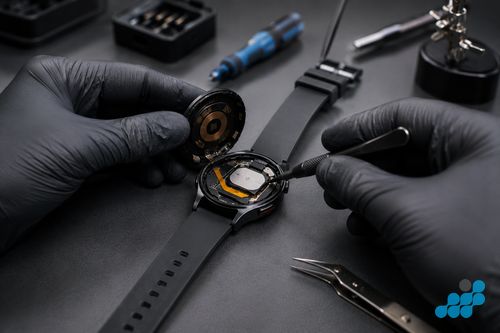
How much is a Galaxy Watch battery replacement?
Galaxy Watch battery replacement runs from our published Galaxy Watch price list, and it is one of the cheaper jobs on the watch. At the top, the Galaxy Watch Ultra battery is £99.95; the mainstream line sits below it — a Galaxy Watch 7 44mm is £79.95, a Galaxy Watch 6 44mm is £69.95, a Galaxy Watch 5 44mm is £64.95, and a Galaxy Watch 4 40mm is £49.95. Within each generation the larger 44mm case sits a little above its 40mm sibling. Every figure is published up front — no quote form — and every battery replacement carries the 27-month guarantee.
Galaxy Watch battery replacement price by model
Prices are fitted, by post, including parts, labour; return delivery follows the order terms. All battery replacements carry the 27-month guarantee. If your exact model is not listed, contact us for a quote.
| Model | Battery replacement (from £) |
|---|---|
| Galaxy Watch Ultra (2024) | £99.95 |
| Galaxy Watch 7 44mm | £79.95 |
| Galaxy Watch 7 40mm | £74.95 |
| Galaxy Watch 6 Classic 47mm | £79.95 |
| Galaxy Watch 6 Classic 43mm | £74.95 |
| Galaxy Watch 6 44mm | £69.95 |
| Galaxy Watch 6 40mm | £64.95 |
| Galaxy Watch 5 Pro 45mm | £74.95 |
| Galaxy Watch 5 44mm | £64.95 |
| Galaxy Watch 5 40mm | £59.95 |
| Galaxy Watch 4 Classic 46mm | £59.95 |
| Galaxy Watch 4 Classic 42mm | £54.95 |
| Galaxy Watch 4 44mm | £54.95 |
| Galaxy Watch 4 40mm | £49.95 |
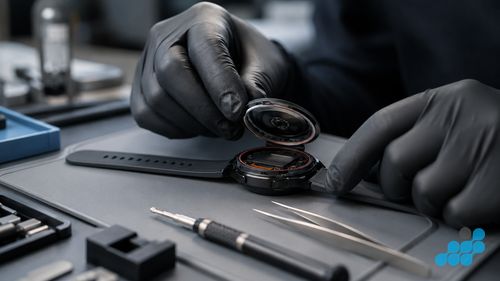
Why Galaxy Watch batteries fade
A Galaxy Watch runs a full Wear OS computer on a cell barely bigger than a coin, and that cell is cycled hard every day — topped up on the wireless charger overnight, then worked through the day by the always-on display, GPS-tracked workouts, continuous heart-rate and SpO2 sensing, and a constant Bluetooth link to your phone. Every charge cycle shaves a little usable capacity, and Wear OS leans on the battery far harder than a simple tracker ever does, so after a year or two the fade is plain: a Watch 5 that comfortably saw out two days now struggles past one, then less. Age, heat — a watch left in a hot car or on a radiator — and repeated deep discharges all hurry it along. None of that is a fault with the rest of the watch; the chipset, the AMOLED and the sensor stack are all fine. The cell has simply worn out, and a fresh one restores the run-time you bought it for. For the full mechanics of battery and power faults, see our Galaxy Watch repair guide.
One safety note worth stating plainly: if the back of your Galaxy Watch is bulging, the cell has swollen. Stop charging it immediately, don't try to power it on, and send it in — a swollen lithium cell is a safety issue and the watch should not be worn until it is replaced.
Why it's a sealed-body repair
Unlike an old phone with a pop-off back, a Galaxy Watch is bonded shut to hold its IP and dust rating. Reaching the cell means softening the adhesive with controlled heat, then separating the rear — the part that also carries the sensor array and the wireless-charging coil — or the display, depending on the model, without cracking either. The old glued cell is disconnected and lifted, a matched-capacity replacement seated in its place, fresh adhesive and a new gasket laid down, and the case closed, re-sealed and function-tested so the original rating is restored. That is why it is a workshop job and not a five-minute swap, and why a cut-price "battery change" with no re-seal is a false economy — you swap a tired cell for a watch that no longer survives the shower, let alone a swim. The battery-reporting calibration is reset afterwards so the percentage read-out stays honest.
Worked through start to finish, the sequence is deliberate. The watch is inspected and its run-time fault matched to the published price for the model before anything is opened, so the invoice never drifts from the quote. Controlled heat softens the rear adhesive, and the case is parted along its factory seam with the display and chassis kept untouched — on a Galaxy Watch the sensor cluster and charging coil sit right where the work happens, so patience here protects more than the screen. The spent cell is released at the board and eased off the chassis whole; a punctured lithium cell is a fire hazard, so it is never levered or pierced. The matched replacement is bonded and reconnected, then the charge controller is reset so the watch reads a full, fresh capacity rather than the old cell's tired curve. A new gasket and adhesive seal the case, a pressure check confirms the IP rating held, and a complete charge-and-drain run verifies the new stamina before the watch is returned. Each of those steps is the reason a proper battery replacement carries a 27-month guarantee where a quick swap carries none.
The same logic governs the repair-versus-replace decision. A Galaxy Watch is not a disposable tracker — it is a Wear OS computer with a quality display, sensors and a body built to last far longer than its first cell. Replacing the cell re-bases the device at the start of its second service life for a fraction of a new watch, and because we return your own watch, your pairing, watch faces and health history travel with it rather than being rebuilt on a fresh unit. The maths only tips the other way when a second major fault — a cracked display, board-level damage, or corrosion — is stacking up alongside the tired battery, in which case the combined estimate approaches replacement and we will say so before you commit.
Signs your Galaxy Watch needs a new battery
The pattern is familiar: the watch no longer lasts a day, the percentage drops suddenly in jumps rather than smoothly, it dies well above 0%, it shuts off in the cold, or the back has started to bulge. If yours is doing two or more of these, the cell is the prime suspect. Our diagnostic confirms it before you commit — and importantly, it rules out the look-alike fault where a watch won't turn on or charge because of corroded charging contacts rather than a dead cell, which is a different, cheaper repair.
How mail-in battery replacement works
Book online, arrange suitable tracked inbound postage using the order instructions, and review the return-delivery terms confirmed for the order.
Is a battery replacement worth it vs a new watch?
Compare the confirmed battery quote with the watch's current value, condition and any additional faults. Synchronise supported data before service because repair can require re-pairing or reset and cannot guarantee preservation. See our Galaxy Watch screen replacement cost guide if the display is also damaged, or compare Apple Watch battery costs.
Galaxy Watch battery replacement — FAQ
How much does a Galaxy Watch battery replacement cost in the UK?
From £49.95 on a Galaxy Watch 4 40mm up to £99.95 on the Galaxy Watch Ultra, with the mainstream Watch 7/6/5/4 sitting between. The exact price is set by your model and case size and is published up front.
Why is my Galaxy Watch battery draining so fast?
Almost always because the lithium cell has degraded through daily charge cycles over a year or two. The always-on display, GPS workouts and health sensing all draw current, and after enough cycles the usable capacity drops. A fresh cell restores the original run-time.
Is a swollen Galaxy Watch battery dangerous — what should I do?
A bulging back means the cell has swollen, which is a safety issue. Stop charging it immediately, don't power it on, don't wear it, and send it in for a battery replacement.
Will my watch stay water-resistant after a battery replacement?
The watch is re-sealed — fresh adhesive and a new gasket — and water-resistance tested to the best achievable standard, though no post-repair seal matches a factory rating. A cheap swap that skips the re-seal is a false economy.
Will I lose my data and watch faces during the battery swap?
No. We work on your own watch rather than swapping it, so your watch faces, health history and phone pairing carry straight over — nothing is wiped or rebuilt.
Can you replace the battery on a Galaxy Watch Ultra / Classic?
Yes — both the Ultra (£99.95) and the Classics (Watch 6 Classic from £74.95, Watch 4 Classic from £54.95) are fully serviceable. The Ultra's larger rugged body makes it a slightly bigger teardown, which is reflected in the price.
Is it worth replacing the battery on an older Galaxy Watch?
Yes. A £49.95–£99.95 battery is a fraction of a new watch and the rest of the hardware is usually fine. It only stops making sense when a second expensive fault stacks up; we flag that honestly.
Ready to send yours in? Book a Galaxy Watch battery replacement.