Coffee Machine Not Pumping Water: Causes & Fixes (UK 2026)
Direct answer: A coffee machine that is not pumping water has one of two causes — a scale blockage, which you can fix at home with a proper descale, or a failed pump or stuck solenoid valve, which needs a repair. The fastest way to tell them apart: if water trickles slowly and you have not descaled in three to six months, descale first. If the machine makes a loud grinding, rattling or cavitation noise — or no pump sound at all — the pump has likely failed. A pump replacement runs £44.95–£124.95 depending on the machine, a valve repair £39.95–£74.95, both covered by the 27-month mechanical guarantee.
There is a particular kind of frustration reserved for the morning your coffee machine runs but no coffee comes out — the pump buzzes, the lights are on, and the group head stays dry. Before you assume the worst, it helps to know that this fault has two very different causes, and one of them costs nothing. Most of the "my machine has stopped pumping" cases we see in hard-water UK areas are scale, not a dead pump; the genuine pump failures are the minority. This guide walks through how to tell which one you have, how to run the correct descale, and exactly what a repair costs if the descale does not work.
It is the diagnostic spoke of our wider coffee machine repair cost hub, with brand-specific pricing in the Sage repair and De’Longhi repair spokes.
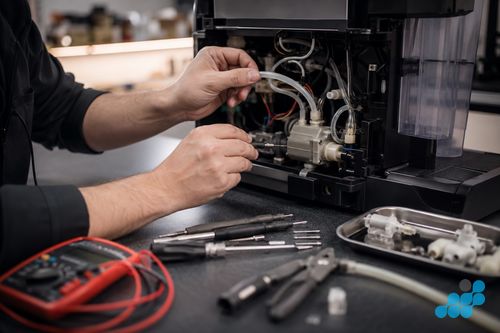
Scale blockage vs pump failure: how to tell
The two causes look identical from the outside — little or no water from the group head — but they sound and behave differently, and the distinction decides whether you reach for the descaler or the phone.
Signs it is scale blockage (fix at home)
- Water trickles or drips slowly instead of flowing, but the pump still makes its normal sound.
- Flow has got gradually worse over weeks rather than failing suddenly.
- The machine is prompting a descale, or you have not descaled in three to six months.
- You live in a hard-water area (most of southern and eastern England).
- Steam pressure has also dropped — scale narrows the whole water path.
Signs the pump has failed (needs a repair)
- No water at all, or a dramatic drop to a trickle, that happened suddenly.
- The pump makes a louder-than-usual buzz, a grinding noise, a rattling or a cavitation whine.
- There is no pump sound at all when you start a brew.
- You have already descaled recently and the problem persists.
- The machine throws a low-pressure or water-flow error code.
The deciding factor is usually the sound. A scaled pump is straining against a narrowed path but still working; a failed pump is either silent, grinding on a dead bearing, or cavitating because it can no longer hold prime.
DIY fix: run a full descale cycle
If the symptoms point to scale, a proper descale is the fix — and it is genuinely worth doing before you spend anything on a repair. Use the descaler matched to your machine and run the full programme, not a quick rinse:
- Sage: Sage-branded liquid descaler, run through the model’s descale programme (the Barista Express and Oracle have a dedicated cycle).
- De’Longhi: De’Longhi EcoDecalk through the machine’s descale programme.
- Jura: Jura descaling tablets, ideally after fitting a fresh CLARIS filter.
- Generic / no branded descaler to hand: citric acid at roughly 2g per 100ml of cold water, run through a brew cycle.
Do not use vinegar. This is the single most repeated piece of bad advice on coffee forums, and it is genuinely harmful: vinegar attacks the rubber seals and internal compounds in an espresso machine, can itself create the leak or failure you are trying to avoid, and may void the manufacturer’s warranty. Branded descalers and citric acid are formulated to dissolve limescale without damaging the machine; vinegar is not.
Run the descale, then flush two or three full water tanks of clean water through the machine to clear any residue, and try a brew. If full flow returns, the fault was scale and you have fixed it for the price of a descaler.
What if it is still not pumping after descaling?
If a thorough descale has not restored flow, the problem is mechanical, not mineral. Three components can be at fault, and they need slightly different repairs:
- The pump itself has failed. The most common post-descale diagnosis. The vibration pump (an ULKA or equivalent on most Sage and De’Longhi machines) has worn out or its internal check-valve has failed. This is a pump replacement — the figures in the table below.
- The solenoid valve is stuck. A partially blocked or failed solenoid valve can mimic pump failure exactly, because it sits in the water path and stops flow even when the pump is healthy. A valve repair is cheaper than a pump.
- The boiler’s thermostat has tripped. Less common, but a tripped overheat thermostat can shut the brew circuit down. A thermostat fix is one of the most affordable coffee machine repairs.
The right way to separate these is a bench diagnosis — a flow-and-pressure test on the pump and a resistance check on the solenoid tell us exactly which has failed, so you pay for the right part the first time.
Pump replacement
A pump replacement is the single most common repair for a "not pumping" machine after a descale has failed. Most Sage and De’Longhi machines use an ULKA-spec vibration pump (a compact electromagnetic pump), which we replace as a sealed module. The table below shows pump and valve prices for the machines we see most often; for every other model see the Sage repair and De’Longhi repair pages.
| Model | Pump replacement | Solenoid valve |
|---|---|---|
| Sage Bambino | £69.95 | £39.95 |
| Sage Barista Express | £79.95 | £44.95 |
| Sage Barista Pro | £89.95 | £49.95 |
| De’Longhi Magnifica Evo | £79.95 | £49.95 |
| De’Longhi Dinamica | £79.95 | £49.95 |
| Nespresso Vertuo Next | £49.95 | £39.95 |
Pump and valve repairs carry the 27-month mechanical guarantee. Diagnostics are deducted from the repair if you proceed.
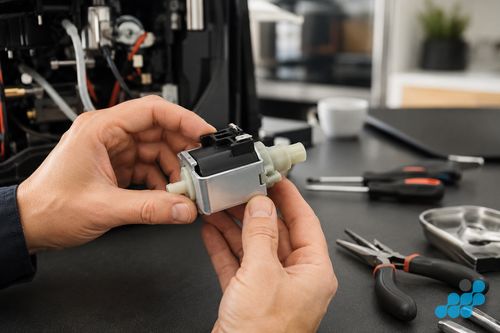
Solenoid valve blockage
Worth a section of its own, because a stuck solenoid valve is the fault most often misdiagnosed as a dead pump — and it is a cheaper repair. The solenoid is an electrically operated valve that opens and closes to direct water to the brew head or the steam circuit; when scale or debris jams it shut, no water reaches the group head even though the pump is healthy. On the bench, a resistance test and a bypass flow test confirm whether the valve is the culprit. A valve repair runs £39.95–£74.95 depending on the machine and carries the 27-month tier (some external water connectors carry the 9-month connector tier).
This is exactly why a bench diagnosis beats guessing. If you swap the pump on a machine whose real fault is a jammed solenoid, you have paid for a pump you did not need and the machine still will not pump — the classic “I replaced the pump and it still doesn’t work” outcome that brings machines to us after a home attempt. Our flow-and-pressure and resistance tests take a few minutes on the bench and tell us unambiguously which component has failed, so the first part you pay for is the right one. The same logic applies to the tripped thermostat: a £39.95–£84.95 thermostat fix resolves some “not pumping” cases entirely, and it would be a waste to condemn a healthy pump over a tripped safety cut-out.
When to book a repair
The rule of thumb is simple. If you have run a proper branded descale and flow has not returned, or if the pump is silent, grinding or cavitating, the fault is mechanical and a repair is needed — and it is almost always worth it, because a pump at £44.95–£124.95 is a fraction of a replacement machine. Book through our contact page; drain the water tank, pack the machine upright in a rigid box with padding around the group head, and follow the accepted inbound-carriage instructions confirmed for the booking. We diagnose under the stated terms, confirm the exact price, fit the OEM-grade part, test under pressure and return it with the guarantee logged. The service runs entirely by post, so you can be anywhere in the UK.
Frequently asked questions
Why is my coffee machine not pumping water?
One of two things: a scale blockage narrowing the water path, or a failed pump / stuck solenoid valve. Scale is fixable at home with a descale; a failed pump or valve needs a repair. The pump’s sound is usually the giveaway — straining is scale, grinding or silence is the pump.
Can descaling fix a coffee machine that will not pump?
Often, yes — in hard-water areas scale is the most common cause of weak or absent flow, and a proper branded descale restores it. If flow does not return after a descale, the pump or valve has failed.
What does a failed coffee machine pump sound like?
A louder-than-usual buzz, a grinding or rattling noise, a cavitation whine, or no pump sound at all. A healthy pump under scale load still sounds normal, just strained; a failed pump sounds wrong or silent.
Can I use vinegar to descale my espresso machine?
No. Vinegar attacks the rubber seals and internal compounds and can void the warranty. Use a branded descaler (Sage, De’Longhi EcoDecalk, Jura tablets) or citric acid at roughly 2g per 100ml.
How much does coffee machine pump replacement cost?
From £44.95 on an entry-level Nespresso capsule machine up to £124.95 on a top-range Sage or Jura bean-to-cup. Pump repairs carry the 27-month mechanical guarantee. See the brand spokes for every model’s exact price.
Is it worth repairing a coffee machine that will not pump water?
Almost always. A pump at £44.95–£124.95 is a fraction of a replacement machine, and the repair carries the 27-month guarantee. The only exception is a control-board fault on the very lowest-priced capsule machine, which we would flag on a diagnostic before you spend.