Coffee Machine Repair Cost UK 2026: Sage, De’Longhi, Jura & More
Direct answer: Coffee machine repair cost in the UK depends on the brand, the model and the fault. A pump replacement — the single most common job — runs from £44.95 on an entry-level Nespresso capsule machine up to around £124.95 on a top-of-range Sage or Jura bean-to-cup. Boilers sit roughly £54.95–£164.95, grinder motors £59.95–£99.95, and control boards £44.95–£154.95. Every figure below comes straight from our live price list — no quote form — and standard mechanical repairs carry a tiered guarantee of 27 months, with control-board (PCB) work covered for 120 days.
A premium espresso machine is one of the most expensive small appliances in a UK kitchen. A Sage Barista Express, a De’Longhi Magnifica, a Jura E8 or a Nespresso Creatista represents hundreds of pounds of investment and, more importantly, a daily ritual people are reluctant to lose. So when the pump goes quiet, the grinder seizes or the display dies, the question is never really "new machine or no coffee?" — it is "who actually fixes these, and what does it cost?" That question has been badly served online, where the results are a mix of brand service centres that quote nothing until the machine arrives, local repairers who do not touch espresso machines at all, and descaling tutorials that solve the wrong problem.
This hub publishes the actual per-fault, per-brand prices we charge for coffee machine repair across the UK by post, drawn from our live price list. It covers the three families that dominate British kitchens — Sage (sold as Breville in some overseas markets), De’Longhi (including its Nespresso capsule range) and Jura — with the common faults, the cost drivers and an honest answer to whether a descale will save you the call-out. The full per-model tables live in the brand spokes: Sage repair cost, De’Longhi repair cost and the dedicated not-pumping-water diagnostic guide.
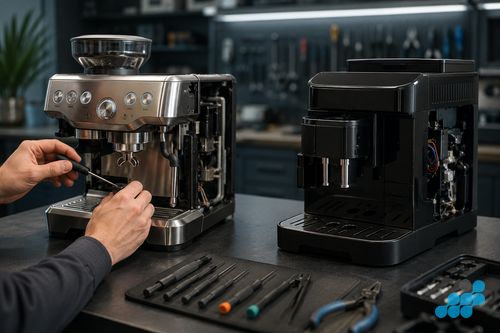
Sage coffee machine repair costs
Sage is the fastest-growing premium espresso brand in the UK, and the Barista Express is the country’s best-selling prosumer machine — which makes Sage pump and grinder failures the single most common job through our workshop. Sage’s own service route (Sage Care) runs on a flat-fee model with no published price, so an independent specialist with per-fault pricing is usually the cheaper and more transparent option once a machine is out of warranty.
For the Sage range, repair prices start at £69.95 for a pump on a Bambino and run to £124.95 on an Oracle Jet. Boiler replacement spans £89.95–£164.95, grinder motors £69.95–£99.95 and control boards £79.95–£154.95. Diagnostics on a Sage are £39.95–£49.95, deducted from the repair if you proceed. Full per-model pricing for every Sage machine in the catalogue — Bambino, Barista Express, Barista Pro, Barista Touch, Oracle, Oracle Touch, Oracle Jet and Dual Boiler — is on the Sage coffee machine repair cost spoke.
De’Longhi coffee machine repair costs
De’Longhi covers the widest spread of any brand here, from the entry-level Nespresso Vertuo Pop capsule machine up to the flagship bean-to-cup Primadonna Elite. That breadth is reflected in the repair prices: capsule machines are cheap to fix (a Vertuo Pop pump is £44.95), while the bean-to-cup Magnifica, Dinamica and Primadonna lines sit a tier above because their pumps, boilers and grinders are larger and the milk-frothing systems add their own failure points.
Across the De’Longhi bean-to-cup range, pump replacement runs £69.95–£109.95, boilers £89.95–£139.95, grinder motors £59.95–£89.95 and milk-frother / LatteCrema assemblies £49.95–£69.95. Control boards sit £79.95–£134.95. Nespresso capsule machines (Vertuo, Essenza, Pixie, CitiZ, Creatista, Lattissima) are generally the most affordable coffee machines to repair of any brand. The complete model-by-model breakdown is on the De’Longhi coffee machine repair cost spoke.
Jura coffee machine repair costs
Jura sits at the premium end of the market and uses a proprietary internal brew unit that makes it a more specialist proposition — most general repair shops decline Jura altogether. We carry Jura-compatible parts across the E-line (E4, E6, E8), the S8, the ENA range and the flagship Z-line, so Jura repairs do not have to mean the eye-watering quote the official Jura service network is known for. Jura pump replacement runs £84.95–£119.95, boilers £109.95–£154.95, grinder motors £74.95–£99.95 and control boards £99.95–£144.95, depending on the model line. Because Jura parts are model-specific, we confirm the exact figure on a diagnostic before any work begins.
Coffee machine repair price guide at a glance
| Fault | What it covers | Typical UK price | Guarantee |
|---|---|---|---|
| Diagnostic | Bench diagnosis, deducted from repair | £39.95–£49.95 | — |
| Pump replacement | ULKA/equivalent vibration or rotary pump | £44.95–£124.95 | 27 months |
| Boiler / heating element | Thermoblock or boiler assembly swap | £54.95–£164.95 | 27 months |
| Grinder motor | Bean-to-cup machines only | £59.95–£99.95 | 27 months |
| Thermostat / PID | Temperature sensor or controller | £39.95–£84.95 | 27 months |
| Steam wand | Wand, tip or steam valve | £39.95–£94.95 | 27 months |
| Valve / connector | Solenoid valve, water connectors | £39.95–£74.95 | 9 months |
| Control board (PCB) | Display, logic board, touch controller | £44.95–£154.95 | 120 days |
These ranges span the lowest-priced capsule machine to the most expensive bean-to-cup; your exact price is the per-model figure in the brand spokes. The tiered guarantee is matched to the repair, not flattened to a single number: mechanical components (pumps, boilers, grinders, thermostats, steam wands, group heads) carry 27 months — valves and connectors carry 9 months, and control-board (PCB) work carries 120 days.
Most common coffee machine faults
No water / pump failure
The single most common fault across every brand. The machine runs but no water — or only a trickle — comes through the group head. In a hard-water area the cause is very often scale narrowing the water path rather than a dead pump, which is why a descale is always the first move (see below). Genuine pump failure tends to announce itself with a louder-than-usual buzz, a grinding or cavitation noise, or complete silence from the pump. See our not-pumping-water diagnostic for how to tell the two apart.
Boiler / heating element
No steam, a steam wand that runs cold, or coffee that comes out lukewarm. On thermoblock machines (most Sage and De’Longhi) the heating element or the boiler itself has failed; on Jura the brew thermoblock is the usual culprit. A boiler repair is a tier above a pump repair in cost but still a fraction of a replacement machine.
Grinder motor and burrs
Specific to bean-to-cup machines (Sage Barista range, De’Longhi Magnifica / Dinamica / Primadonna, all Jura). Symptoms are a grinding noise with no grounds produced, a seized burr set, or an error code pointing to the grinder. Often the burrs are simply worn or jammed with an oily bean — a burr service is cheaper than a motor swap, so we diagnose before quoting.
Thermostat / PID failure
The machine brews at the wrong temperature — sour or burnt shots that track back to temperature, not the beans. Common on older Barista Express machines where the PID controller or a thermistor drifts. A thermostat repair is one of the most affordable fixes in the table.
Control board (PCB) failure
A blank display, unresponsive buttons or a touch screen (Barista Touch, Oracle Touch, Creatista, Primadonna) that has died. This is the highest-cost single repair because the logic board is the most expensive component, and it is the one repair type we cover for 120 days rather than 27 months.
Steam wand and milk system
No steam pressure, a blocked wand tip, or a LatteCrema / milk carafe that has stopped frothing. Often this is milk-protein scale rather than a failed part and a deep clean resolves it; where the solenoid or steam valve has failed, it is a straightforward mechanical repair.
Before booking: is it just scale?
This is the advice that genuinely saves you money, so it comes before any booking. Scale build-up is the great mimic of pump failure: limescale narrows the water path until the machine behaves exactly as if the pump has died — slow flow, low pressure, sometimes a complete stop. In a hard-water area like much of the UK, a machine that has not been descaled in three to six months may simply need a descale cycle, not a repair.
Run a full descale with the correct branded descaler before booking: Sage liquid descaler through the model’s descale programme, De’Longhi EcoDecalk through its programme, and Jura descaling tablets with a fresh CLARIS filter. Do not use vinegar — it attacks the seals and internal compounds and can itself create the failure you are trying to avoid. If a proper descale restores full flow, there is no repair to book. If it does not, you have at least ruled scale out and the fault lies with the pump, valve or board.
What a coffee machine repair actually involves
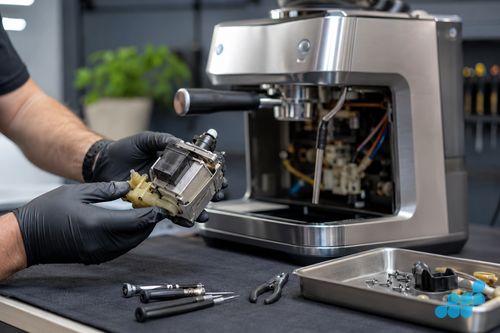
A coffee machine is not a single component but a small hydraulic system — a water tank, a pump, a boiler or thermoblock, a solenoid valve, a group head and (on bean-to-cup machines) a grinder and brew unit, all governed by a control board. The bench process follows that system. We bench-test the machine to reproduce the fault, strip the casing, trace the water path and isolate the failed stage: a flow test tells us whether the pump is generating pressure, a continuity test on the heating element tells us whether the boiler is the problem, and a resistance check on the solenoid tells us whether a stuck valve is blocking flow that mimics pump failure.
Once the fault is pinned, the failed component is swapped for an OEM-grade or genuine part — an ULKA or equivalent vibration pump for most Sage and De’Longhi machines, a matched thermoblock or boiler assembly, a burr set or grinder motor, or a logic board on the touch models. The machine is then reassembled, run through a full brew and steam cycle, checked for leaks under pressure, and temperature-tested before it goes back. The tiered guarantee is logged against the serial number so it follows the repair, not the invoice.
How mail-in coffee machine repair works
celltech is a UK-wide mail-in specialist, and the service runs entirely by post — you can be anywhere in the country. Before posting, drain the water tank completely, remove and separately wrap the portafilter and drip tray, and pack the machine upright in a rigid outer box with plenty of padding around the group head (the most damage-prone part in transit). Use a tracked service that accepts the packed machine and provides compensation cover suitable for its value. One realistic note: the larger bean-to-cup machines are heavy, so empty the water tank and bean hopper fully and pack the machine well in a sturdy box before posting — or contact us before sending it if shipping a bulky unit is impractical. We diagnose under the stated terms, confirm the exact price from the tables above, fit the part, test and return it under the delivery terms shown for the order with your guarantee logged. Start the process on our contact page.
For comparison reading on premium home-appliance and lifestyle-tech repair, see the broader smart home device repair cost hub.
Is your coffee machine worth repairing?
Almost always. A pump replacement at £69.95–£124.95 or a boiler at £89.95–£164.95 is comfortably under a third of the cost of replacing a Sage Barista, a De’Longhi Magnifica or a Jura E8 — and these machines are engineered for a long service life when they are maintained and descaled. The only honest exception is a control-board failure on the very lowest-priced capsule machine, where the PCB repair can approach the cost of a replacement; we will always tell you that before you spend, because a diagnostic that says "replace, don’t repair" is the right outcome too.
Frequently asked questions
How much does coffee machine repair cost in the UK?
It depends on the brand and fault. A pump replacement — the most common job — runs from £44.95 on a capsule machine to around £124.95 on a top-range bean-to-cup; boilers sit £54.95–£164.95, grinder motors £59.95–£99.95 and control boards £44.95–£154.95. Every per-model figure is published in the brand spokes — no quote form.
Is it worth repairing a Sage (Breville) coffee machine?
Yes. A Sage Barista Express, Pro or Oracle is a premium machine, and a pump or grinder repair is a small fraction of its replacement cost, underwritten by the 27-month guarantee on mechanical work. Sage is sold as Breville in some overseas markets; in the UK the brand is Sage and we service the full range.
What is the most common coffee machine fault?
Pump failure or a no-water fault — though in hard-water areas scale build-up mimics it. Always run a full descale first; if flow does not return, the pump, valve or board is the cause.
Can a De’Longhi Magnifica be repaired by post?
Yes. The full De’Longhi bean-to-cup range — Magnifica, Dinamica, Eletta, Primadonna, Rivelia — is serviceable by mail-in across the UK, along with the Nespresso capsule range. See the De’Longhi repair cost spoke.
Should I descale before booking a repair?
Always. Use the correct branded descaler (Sage, EcoDecalk for De’Longhi, Jura tablets) and never vinegar. If a descale restores full flow, there is no repair to book — which is the outcome we want for you.
Can a coffee machine control board (PCB) be repaired, and what does it cost?
In most cases the board is replaced rather than component-repaired, costing £44.95–£154.95 depending on model. Control-board work carries the 120-day tier of guarantee rather than the 27 months that mechanical repairs carry.
What guarantee do you offer on coffee machine repairs?
27 months on mechanical components (pumps, boilers, grinders, thermostats, steam wands, group heads) — 9 months on valves and connectors, and 120 days on control-board (PCB) work. The tier is matched to the repair type.