Drone Crash Damage Repair by Post UK 2026: DJI & More
Direct answer: Yes — most crashed drones can be repaired, even with significant shell, gimbal and motor damage combined. The real question is whether the repair cost is less than the drone’s current replacement value, and celltech answers that with a diagnostic and a no-obligation quote on every crash repair. We accept drones UK-wide by insured post; the flight battery must be removed before posting under the selected carrier lithium-polymer rules. For indicative costs by model and fault, see our DJI repair price table.
A crash is the moment drone ownership stops being fun and starts being arithmetic. The drone is on the ground, the gimbal is pointing the wrong way, an arm is bent, and you are trying to work out whether this is a repair or a write-off — usually with very little information, because most general repair shops do not touch drones and DJI’s own route wants the craft sent away before it will commit to a number. This page exists to give you a clear, calm process for exactly that moment: how to assess the damage yourself, how to post a crashed drone safely (including the battery rules almost everyone gets wrong), what happens after it reaches us, and how an independent crash repair compares to DJI Care Refresh. It is the conversion spoke of our DJI drone repair cost hub; for specific component pricing see the gimbal and motor & propeller pages.
celltech is not a phone shop that occasionally sees a drone — we run dedicated drone repair capability, so a crashed DJI, Autel, Parrot or FPV craft arriving in pieces is routine bench work, not a curiosity.
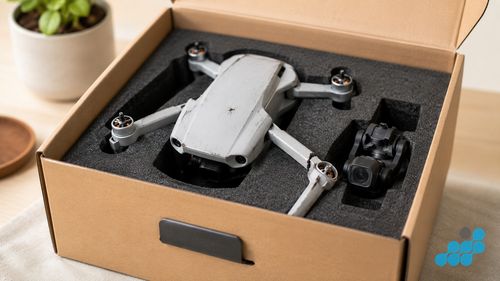
Crash damage self-assessment
Before you pack anything, walk through the damage. A structured self-assessment sharpens your own expectations and gives us accurate information when you book. Do not power the drone on if it has been wet — that can turn recoverable liquid damage into a board failure — and do not try to fly it to “see if it still works”; a damaged arm or gimbal flown hard becomes a much bigger crash.
Shell & frame damage
Look for cracks in the upper or lower shell, a bent or twisted arm, an arm that no longer folds and locks cleanly, and any separation at the seams. Shell damage on its own is cosmetic-plus-structural and usually straightforward; a twisted arm that has stressed the motor mount or the ESC underneath is the version to flag, because the visible bend often points at propulsion damage beneath.
Gimbal damage
Check whether the camera still moves freely through pan, tilt and roll, whether the gimbal hangs loose or at an odd angle, and whether there is a visible tear in the ribbon cable at the pivot. A gimbal that powers up but shakes, drifts or shows a calibration error is often repairable at the component level; a gimbal physically knocked off its mount needs bench inspection.
Motor & propeller damage
Spin each propeller by hand. A motor that grinds, ticks or feels rough has a bearing issue; a motor that will not turn at all may have seized or lost its ESC channel. Inspect each propeller for bends, chips and cracks — and remember that a propeller that looks fine can still be out of balance if the arm took a shock. See our motor & propeller repair guide for the propulsion detail.
Camera damage
A cracked lens, a sensor showing spots or lines, or a black feed while the gimbal still moves all point at camera-module damage. The camera and gimbal are integrated on most consumer drones, so camera damage is assessed alongside the gimbal — we do not swap the whole assembly when only the sensor or a gimbal component is at fault.
Total loss vs repairable
The honest test is the beyond-economic-repair threshold: when the combined cost of the faults approaches the drone’s current second-hand value, repair stops making sense. Single-fault crashes are almost always repairable; compound crashes — shell plus gimbal plus motor plus camera — reach the threshold more often. We make that call for you, free, after the diagnostic, and we will tell you plainly if you are better off replacing the craft.
How much does crash damage repair cost?
Rather than reproduce figures here, we point you to the full per-model table on our DJI drone repair cost hub, where every fault type — gimbal motor, gimbal calibration, gimbal ribbon, motor, ESC, shell, camera, battery, propeller — is priced by model. Crash damage is usually a combination of these, so the way to estimate a compound repair is to add the relevant lines for your model. For example, a Mini 4 Pro that has come down hard and damaged both its gimbal motor and its shell would combine the gimbal motor and shell figures from the hub table to give an indicative compound total — read those figures directly from the hub, since we keep pricing in one place so it never drifts out of sync.
We confirm the diagnostic, repair and return-delivery terms before work begins. Once the fault has been assessed, we provide a quote and explain if the repair appears uneconomical. If you decline the repair, the stated diagnostic and return terms still apply.
Posting a drone — the battery rule
This is the part most owners get wrong, and it matters. Drone flight batteries are lithium-polymer (LiPo) packs, and LiPo batteries are restricted items under both Royal Mail and Parcelforce rules. The body of the drone, with the battery removed, posts as ordinary tracked parcels; the battery itself must travel separately and packaged to the carrier’s lithium guidance — terminals taped against short-circuit, the pack in its own compartment, and within the carrier’s watt-hour limits. A swollen or physically damaged battery is a more serious restricted item again and may need specialist handling; tell us if you suspect this before posting. If you are unsure whether your carrier will take a given battery, contact us and we will walk you through it. The short version: post the body, handle the battery to the carrier’s rules, and never pack a swollen LiPo as if it were ordinary cargo.
How to pack a crashed drone for posting
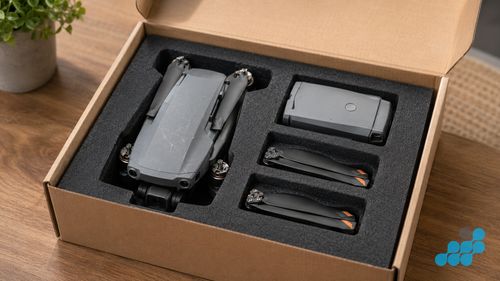
- Remove the propellers and the flight battery before packing — always.
- Photograph all the damage before sealing the parcel, and note each fault on a short written list enclosed with the drone.
- Immobilise the gimbal. Cushion around it so it cannot move in transit — a loose gimbal that rattles in the box is how some repairable drones arrive with secondary damage.
- Double-box with foam or bubble wrap so the body cannot shift. The original DJI box, if you still have it, is ideal; otherwise a rigid double-walled box with foam lining.
- Keep the battery separate and packaged to your carrier’s LiPo guidance.
Our general packing advice covers the underlying principles — immobilise, cushion, photograph — and our is it safe to post guide addresses the security side. Both adapt directly to drones; the gimbal is simply the part that needs the most attention.
Which postal service to use
For the drone body — battery already out — choose a tracked service that accepts the packed device and provides compensation cover suitable for its value. The battery needs separate attention because lithium rules differ by carrier and by the pack’s watt-hour rating, so confirm that your selected carrier will accept that specific cell before sending it. Tell us your model when you book and we will help you check the requirements for both halves.
What happens after you post your drone
The process is deliberately simple. Receipt — we confirm the drone has arrived and log the damage you described. Diagnostic — the craft is bench-inspected end to end, each assembly assessed, and the actual faults confirmed against your self-assessment. Quote — we send a total drawn from the published per-model prices on the hub, with the beyond-economic-repair call made honestly if it applies. Approval — you decide after all applicable diagnostic, specialist, third-party and return charges, including terms for declining, are confirmed. Repair — the work is done, with mechanical repairs underwritten by 27 months, charging work by 9 months, and board-level or liquid work by 120 days. Return — the drone comes back under the order terms, with the guarantee logged.
DJI Care Refresh vs independent repair
DJI Care Refresh is DJI’s own cover programme, and it is genuinely useful in the right circumstances — chiefly for a recently purchased drone that suffers a covered incident within the plan’s terms, where the replacement fee is lower than an independent repair. Its limits are the ones that bring people to us: it is tied to plan terms and incident counts, it does not cover every fault or an out-of-warranty older model, and once exhausted the next incident is full price. Independent repair is usually the better route for an out-of-warranty craft, a drone past its plan, or a fault that falls outside cover — and because we triage to the specific failed component rather than defaulting to a full assembly swap, the bill is often lower even before plan limits come into it. The two are not mutually exclusive: if Refresh covers your incident, use it; if it does not, an independent repair is the alternative.
Crucially, we also take on crash damage that DJI Care declines or that falls outside the plan — older models, exhausted incidents, faults excluded from cover. If you have been told the craft is not eligible, ask us before you write it off.
Frequently asked questions
Can a crashed DJI drone be repaired?
Yes, in most cases — even with shell, gimbal and motor damage combined. We assess every assembly free and quote the combination, calling out honestly where the total crosses into beyond-economic-repair territory. See the per-model pricing on our DJI repair cost hub.
Can I post a drone for repair? What about the battery?
Yes — we accept drones UK-wide by insured post. The flight battery must be removed and posted separately to your carrier’s lithium-polymer rules (terminals taped, within Wh limits); the body posts as ordinary tracked parcels. A swollen battery needs specialist handling — tell us before posting.
How do I pack a crashed drone to post it safely?
Remove the propellers and battery, photograph all damage, immobilise and cushion the gimbal so it cannot rattle, double-box with foam, and keep the battery separate. Full detail is in the packing section above.
Is independent drone repair better than DJI Care Refresh?
It depends. Refresh is good for a recent drone with a covered incident inside the plan’s terms. Independent repair is usually better for out-of-warranty craft, exhausted plans, or faults outside cover — and we triage to the specific component, which often lowers the bill.
How do I know if my crashed drone is beyond economic repair?
When the combined cost of the faults approaches the drone’s current second-hand value. Single-fault crashes rarely reach it; compound crashes (shell plus gimbal plus motor plus camera) reach it more often. We make that call free after the diagnostic and tell you plainly.
Will celltech repair crash damage not covered by DJI Care?
We assess supported older models and faults outside a manufacturer plan. Diagnostic terms and any return charge are confirmed before work, followed by a repair-specific quote.