Smart Home Device Repair Cost UK 2026: Ring, Nest, Echo & More
Direct answer: Smart home device repair in the UK is priced by brand and fault, not as a flat fee — a Ring doorbell battery is from around £39.95, a Nest thermostat display from £49.95, an Amazon Echo speaker from £39.95, a Hive thermostat display from £49.95, and a Blink or Arlo camera from £39.95 and £44.95 respectively. celltech repairs Ring, Nest, Echo, Hive, Blink and Arlo by post UK-wide, with a tiered guarantee of 27 months on screens, batteries, cameras, speakers and buttons, and 9 months on charging ports and connectors. Every price below comes straight from our live price list — no quote form.
Smart home devices are the strange blind spot of UK repair. A Ring doorbell stops charging, a Nest thermostat goes blank, an Echo distorts — and the owner discovers that almost no high-street shop will touch them. The manufacturer’s support flow gently steers toward buying a replacement, and a perfectly good device that cost good money two or three years ago heads for a drawer, then a landfill. That gap is exactly what this hub exists to close. We publish real repair prices for the six smart home brands UK owners actually run — Ring, Nest, Amazon Echo, Hive, Blink and Arlo — so you can decide between a £39.95 battery and a whole new device before you spend anything.
This is the hub for the smart home cluster; the full per-model tables live in the spokes — Ring doorbell repair, Nest thermostat & doorbell repair and smart speaker & Echo repair. For neighbouring appliance repair, see our coffee machine repair cost guide.
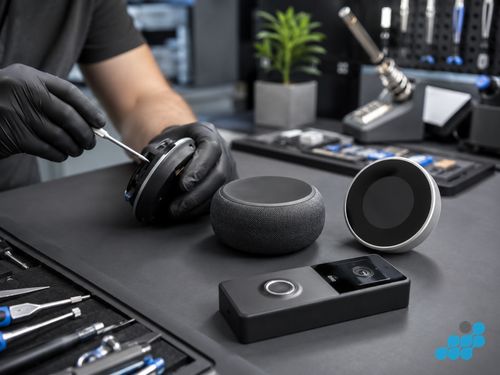
Ring doorbell & camera repair costs
Ring is the UK’s dominant smart doorbell and camera brand, and the faults fall into a predictable pattern. On battery-powered models (Video Doorbell 2, 3, 3 Plus, 4, Battery Doorbell Plus and Pro), the rechargeable pack degrades over two to three years of charge cycles and stops holding charge — battery replacement is the single most common Ring job, from £39.95 on a Video Doorbell 2 up to £49.95 on a Battery Doorbell Pro. On wired models (Pro, Pro 2, Wired), there is no removable battery, so a “won’t hold charge” symptom is usually the charging circuit or power supply rather than a pack swap. Camera module failure — no video, a blurry feed, a black screen — is the other common fault, especially on outdoor units after years of UV exposure, running from £49.95 on a Video Doorbell 2 up to £79.95 on a Video Doorbell Pro 2. Speaker, mic, Wi-Fi and motion-sensor faults round out the list. Full per-model pricing is on the Ring doorbell repair page.
Nest thermostat & doorbell repair costs
Google’s Nest line splits into three very different repair profiles. The thermostats (Learning Thermostat 4th and 3rd Gen, Thermostat E, Nest Thermostat 2020) most often fail on the display — blank, flickering or unresponsive — with display replacement from £49.95 on a Thermostat E up to £79.95 on a Learning Thermostat 4th Gen; the heat link, the box that talks to the boiler, fails separately and is repairable from £39.95 to £54.95. The doorbells and cameras (Nest Doorbell Wired and Battery, Nest Cam variants) most often fail on the camera module, from £54.95 on an indoor wired cam up to £69.95 on a floodlight or battery unit. The Hub and Audio line (Nest Hub, Nest Hub Max, Nest Audio, Nest Mini) fails on display or speaker, with Nest Hub display replacement from £69.95 to £89.95. One honest caveat: mains-wired units — the Nest heat link, hard-wired thermostat bases and wired doorbells — must be safely disconnected before posting and refitted afterwards by a competent person; celltech repairs the device, not your home wiring. Full pricing is on the Nest repair page.
Amazon Echo & Echo Show repair costs
The Amazon Echo range is the UK’s most-deployed smart speaker family, and the failures concentrate in two places. On the speaker-only devices (Echo, Echo Dot, Echo Pop, Echo Studio), the speaker driver deteriorates — distorted, quiet or silent audio — with driver replacement from £39.95 on an Echo Dot (3rd Gen) up to £64.95 on an Echo Studio; the mic array is the other common fault, when Alexa stops hearing commands, from £39.95 to £39.95. On the screen devices (Echo Show 5, 8, 10, 15 and 21), the display is the high-value failure — cracked or dead — running from £44.95 on an Echo Show 5 (2nd Gen) up to £119.95 on an Echo Show 21. Power-board and Wi-Fi faults round out the range. Full per-model pricing, including the Nest Audio and Nest Mini for comparison, is on the smart speaker repair page.
Hive, Blink & Arlo
Beyond the big three, three further brands round out the UK smart home. Hive thermostats (Hive Thermostat, Thermostat Mini) fail on the display and the receiver/heat-link side, with thermostat display from £49.95 to £59.95, receivers from £44.95 and heat links at £49.95; Hive’s cameras and sensors carry their own pricing. Blink (an Amazon brand) cameras — Outdoor 4, Mini, Mini 2, Floodlight — fail most often on the camera module, from £39.95 on a Blink Mini up to £54.95 on a Blink Floodlight Camera, with battery replacement from £39.95. Arlo cameras (Ultra 2, Pro 5S, Pro 4, Essential) carry dearer modules reflecting their premium positioning, with camera replacement from £44.95 on an Arlo Essential Indoor up to £79.95 on an Arlo Ultra 2, and battery from £39.95 to £54.95. Where a specific Hive, Blink or Arlo fault is not in our live price list, we quote individually.
Most common smart home faults
- Battery drain / won’t hold charge (Ring battery doorbells, Nest battery cam, Arlo, Blink) — the dominant failure across battery-powered devices after two to three years.
- Speaker distortion or silence (Echo, Nest Audio) — a deteriorated driver; far cheaper than a new speaker.
- Camera module failure (Ring, Nest, Arlo, Blink) — no video, blurry feed or black screen, often on UV-exposed outdoor units.
- Wi-Fi connectivity drop (all brands) — a Wi-Fi chip or antenna fault, once router and placement issues are ruled out.
- Display failure (Echo Show, Nest Hub, Nest thermostat) — blank, flickering or cracked screen.
Repair vs replace: smart home devices
The arithmetic almost always favours repair. A Ring battery at £39.95, an Echo speaker driver at £39.95 or a Nest thermostat display at £49.95 is comfortably under half the price of a replacement device — and that is before the hidden cost of replacement, which most owners forget: re-pairing the new device back into the ecosystem, redoing routines, and losing the configuration the old device carried. Repairing in place keeps your smart home setup intact and keeps a working device out of landfill. The one case that flips the sums is an older unit limping along with several faults at once, where the parts together creep toward the price of a new device — we put that on the table plainly at the diagnostic rather than stacking repairs onto something near the end of its life.
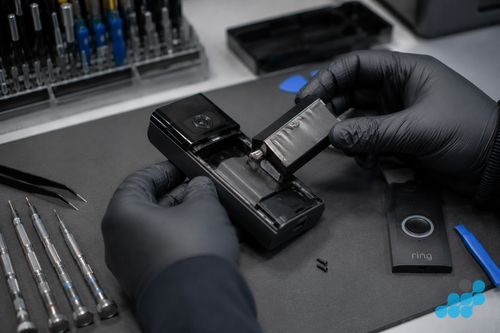
What a smart home repair actually involves
Smart home devices are mostly small, sealed assemblies, and the bench process is dominated by careful opening rather than the part swap itself. A Ring doorbell is split at its seam, the battery or camera module is disconnected from the main board, the replacement is seated and the unit resealed to its original weather rating — the reseal matters, because a Ring or Arlo that goes back outdoors with a compromised seal fails again within a season. A Nest thermostat is opened from the back, the display PCB is detached and the replacement calibrated so the screen registers touch and rotation correctly. An Echo is split at its grille seam, the driver or mic array is replaced, and the device is reassembled and audio-tested.
The diagnostic stage is where most of the value sits. A Ring that “won’t charge” might be a degraded battery, a worn charging port, a failed charging circuit, or simply a dead charging cable — each a different repair at a different price, and the cable is free to rule out at home. An Echo that “can’t hear you” might be a mic array fault, a Wi-Fi issue, or a software setting — only the first is a hardware repair. We pin down which it is before quoting. See our data during a repair guide for how we handle the account and configuration side.
How mail-in smart home repair works
The whole cluster runs by post, because that is how celltech reaches owners across the country. Pick the brand you need — Ring repairs start at /repair/smarthome/ring — and, before posting, deregister the device from its app where the manufacturer recommends it. Do not include account credentials. Box it in its original packaging if available, otherwise use suitable protective packaging, and choose an inbound service appropriate to the device and value. Diagnostic charges and approval terms are shown with the repair.
Two device-specific habits help: pull the batteries out of doorbells and sensors before they travel, and wrap any smart speaker so the mesh grille arrives undented.
When it lands on the bench we diagnose it, confirm the figure straight from the published list, fit the part, test it end to end, and post it back under the delivery terms shown for the order with the guarantee logged against it. No journey to a counter is needed — wherever you are in the UK works.
Genuine-grade vs aftermarket parts
We fit OEM-grade camera modules, battery packs, speaker drivers and displays matched to the original specification, and we tell you exactly what is going in before any work starts. Aftermarket smart home parts are the false economy of this category: a cheap camera module is washed-out and noisy, a cheap battery pack swells sooner and holds less charge, and a cheap speaker driver distorts at the volumes these devices are asked to fill a room at. On an outdoor Ring or Arlo, an aftermarket seal fails the weather rating. See our genuine vs OEM-grade parts guide for the full breakdown.
What drives a smart home repair cost
There is no flat smart home repair fee, because the category is really six unrelated machines wearing one label. A handful of factors decide where any given quote lands.
- Which brand, which box. A Ring doorbell, a Nest thermostat and an Echo Show share a shelf and almost nothing else. The money sits in a different place on each — the doorbell’s battery pack, the thermostat’s display PCB, the speaker’s driver cone — so an “average” figure across the cluster would tell you nothing. The device in your hand sets the part, and the part sets the price.
- Powered by cell or by mains. Battery devices — Ring battery doorbells, Nest battery cams, Arlo and Blink — carry a rechargeable pack that wired kit simply does not have, and that pack is its own failure mode. The catalogue only prices a battery where the model genuinely ships with one.
- Lived indoors or out in the weather. Anything bolted to an outside wall — doorbells, floodlight and spotlight cams — ages on its optics and its seal, worn down by British rain and summer UV; the same brand sitting indoors tends to give up on its speaker, mic or power board instead. Years of outdoor life is the strongest signal that a job will turn out to be camera-module work.
- How clean the diagnosis is. A smart home complaint — “it won’t charge”, “it can’t hear me”, “it keeps dropping off Wi-Fi” — rarely points at one cause, and several of the candidates are not hardware at all. The free bench diagnostic settles which one it actually is before a price is named, so you never fund the wrong part.
celltech vs the manufacturer push-to-replace
If the device is still under its manufacturer warranty, check the current support route before paying for a repair. For an out-of-warranty device, compare the manufacturer’s current options with a Celltech repair quote. We confirm the price and applicable terms before work begins; standard repairs include diagnostics and carry the repair-specific warranty shown in our published terms.
Frequently asked questions
Is it cheaper to repair a Ring doorbell or buy a new one?
Almost always repair. A Ring battery starts at £39.95 and a camera module at £49.95 — comfortably less than half the price of a new unit — and fixing the one you own leaves your Ring setup, stored footage and routines exactly as they were. The per-model figures sit on the Ring doorbell repair page.
Can a Nest thermostat display be repaired?
Yes — a dead, flickering or unresponsive Nest screen comes off as a module and a fresh one goes on, from £49.95 on a Thermostat E up to £79.95 on a Learning Thermostat 4th Gen. A misbehaving heat link is a separate job. Full detail is on the Nest repair page.
Does celltech repair Amazon Echo devices?
Yes — every Echo we list, screens included. A speaker driver is from £39.95, mic-array work from £39.95, and an Echo Show display runs £44.95 to £119.95 depending on panel size. The model-by-model breakdown is on the smart speaker repair page.
How much does Ring doorbell battery replacement cost in the UK?
£39.95 on a Video Doorbell 2, rising to £49.95 on a Battery Doorbell Pro — fitted, posted back and covered for 27 months. The wired Ring models have no pack to swap, so a charge complaint on one of those points at the charging circuit instead.
Can I send a smart home device by post for repair?
Yes — every brand on this hub can reach us by post from anywhere in the UK. Deregister it in its app first (Ring app, Google Home or your Amazon account) so your data stays with you, then pack it in the original box or a padded bag and follow the inbound instructions confirmed for the booking.
Do I need to deregister my smart home device before sending it in?
Yes — it is the one step worth not skipping. Pulling the device out of its app severs its tie to your account, your stored footage and your routines while it is on the move and on the bench; you add it back when it returns. We never need a login of yours to do the repair.
What guarantee comes with smart home device repairs?
27 months on screens, batteries, cameras, speakers and buttons — more than twice the cover most independents put on the same work. Charging ports and connectors run on the 9-month tier.