How celltech Prices Repairs: A Transparent Cost Breakdown
"How much to fix my screen?" ought to be a simple question. In most of the UK repair market it is anything but. You fill in a quote form, hand over your contact details, and wait — sometimes to be told a price, sometimes to be drawn into a sales conversation, and almost never to be told why the number is what it is. This page does the opposite. It shows you the actual logic celltech uses to price every repair, the formula behind it, and what is and isn't included in the figure you see. There is no quote form here and no mystery.
We do this for two reasons. First, because transparency is the right way to treat people who are trusting you with a device they depend on. Second, because an understood price is rarely objected to — almost every "why is it that much?" melts away the moment you can see the parts cost, the labour, and the warranty sitting behind the number. The data that proves these prices are honest lives in our UK Device Repair Report 2026; this page explains how each of those figures is built.
Direct answer: celltech prices every repair from one simple, consistent formula: the cost of the part plus the labour to fit it, multiplied to cover diagnostics, testing, overheads and our tiered guarantee. Parts vary by quality tier (genuine, OEM-grade, aftermarket) and labour varies by difficulty — which is why a published, per-model price for your exact device beats a vague "from £X" online quote.
The simple formula behind every price
There is no black box. Every published celltech price is built from the same expression:
(Parts + Labour) × 1.5 = your price
That multiplier — 1.5 — is not a markup invented to squeeze margin. It is the figure that covers everything the raw parts-and-labour cost does not: the time spent diagnosing before any work starts, the function testing afterwards, the workshop overheads (equipment, microscopes, hot-air stations, clean facilities), the parts warranty, and the guarantee that follows the repair home. Strip the multiplier away and you would be paying for the part and the fitter's minutes but none of the infrastructure that makes the repair reliable.
A worked example
Take a real, current celltech repair: an iPhone 13 screen replacement at £74.95. The published price breaks down structurally as the screen part itself, plus the labour to open the phone, transfer the earpiece and Face ID components, fit and reseal the new assembly, and then function-test touch, display and True Tone. The 1.5 multiplier folds in the free diagnosis that confirmed the screen (not, say, a board fault) was the true culprit, the post-repair test, and the 27-month guarantee attached to that screen.
Compare that with an iPhone 15 screen at £179.95. The labour portion is broadly similar — it is the same physical job — so almost the entire difference is the part: a more expensive, more tightly controlled OLED panel. The formula is identical; only the parts input has changed. That is exactly why two screens can cost very different amounts and still both be fairly priced.
Parts: genuine, OEM-grade and aftermarket
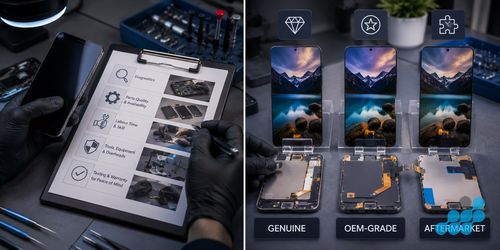
Parts are the single biggest variable in any repair price, and the part you choose is the single biggest decision you make. We offer three quality tiers, and we tell you which one is being fitted — never a bait-and-switch where a premium price buys a budget part.
| Tier | What it is | Best for |
|---|---|---|
| Genuine | The original manufacturer part, or a part sourced to that exact specification | Devices under manufacturer warranty considerations, exact colour and calibration match |
| OEM-grade | A part built to the original specification by a quality manufacturer, without the brand premium | The sweet spot for most customers — like-for-like performance at a lower cost |
| Aftermarket | A functional, economical part that meets the job but may differ in colour accuracy or longevity | Budget-led repairs on older or low-value devices |
Why does this matter for price? Because a genuine flagship OLED panel can cost several times what an equivalent aftermarket panel costs, and that parts difference flows straight through the formula into the final figure. When you see an iPhone 13 screen at £74.95 and a premium-grade iPhone 14 screen at £199.95, you are mostly looking at parts cost, not labour — and the tier you select moves the number accordingly.
Labour: why a screen swap and a microsolder aren't the same
If parts explain the difference between two screen repairs, labour explains the difference between two entirely different kinds of repair. A screen swap is a procedural job: open, transfer, fit, seal, test. It takes skill and care, but the steps are well-defined and repeatable. A board-level microsolder is a different discipline entirely: tracing a fault to a single component on a densely packed logic board, under a microscope, with hot-air and fine-tip rework — work that most independents simply do not offer.
That labour difference is why the formula produces very different prices for repairs that might sound similar to a customer. "My phone won't charge" could be a £64.95 charging port replacement — a procedural component swap — or it could be a fried charging IC on the logic board that needs microsoldering to identify and replace. The symptom is identical; the labour, the skill required, and therefore the price, are not. Honest diagnosis exists precisely to tell these apart before you spend a penny.
Why we publish prices when others don't
Most of the UK repair market hides behind the quote form for a reason that is not flattering. A hidden price is a price the shop can change based on who is asking, what they think you will pay, and whether you sound like you are comparing quotes. A published price removes all of that. When the iPhone 13 screen is £74.95 for everyone, on the page, before any contact details change hands, you can compare it like-for-like with anywhere else and decide in your own time.
Publishing also disciplines us. A price that is public has to be defensible — if we could not explain it through the (parts + labour) × 1.5 logic above, we would not be able to stand behind it in the open. That is a feature, not a burden. The full per-model breakdowns sit on our cost hubs — for example iPhone screen replacement costs, Apple repair costs, Samsung screen repair costs, HP laptop repair costs, Dell laptop repair costs, Lenovo laptop repair costs, OnePlus repair costs, Xiaomi repair costs, Garmin watch repair costs and Steam Deck repair costs.
What's included in your price
A common and fair question is "what am I actually getting for that figure?" The answer is more than just the part and the fitting. Every celltech price includes:
- Free diagnosis on standard repairs — the true root cause is confirmed, not assumed, before any work begins. (Board-level and data-recovery work carries a diagnostic fee that is deducted from the repair if you proceed.)
- Function testing — the repair is validated against the original fault before the device is returned.
- The tiered guarantee — 27 months on screens, batteries and standard components; 9 months on charging ports and connectors; 120 days on board-level, liquid-damage and data-recovery work.
- Parts honesty — the parts tier you pay for is the parts tier you receive, stated up front.
The 27-month figure on standard components is more than double the 12 months most independent repairers offer — and we frame it that way rather than claiming to be the "most generous" or "lowest-priced", because those are claims we cannot universally verify and would rather not make. The shorter tiers on connectors and board-level work honestly reflect the greater complexity and risk of those repairs; 120 days is still substantial.
Why the same repair varies by model
If the formula is constant, why does "a screen repair" cost £74.95 on one phone and £279.95 on another? Three factors, all flowing through the parts and labour inputs:
- Panel type. OLED panels cost far more than LCDs, and larger or higher-resolution panels cost more still. A flagship OLED is the biggest single driver of a high screen price.
- Parts scarcity and serialisation. Parts that are serialised or tightly controlled by the manufacturer are harder and costlier to source. Where a part requires genuine pairing (certain Face ID and display components), that constraint is priced in.
- Assembly complexity. Some devices are glued, some screwed, some require component transfer (earpiece, sensors) from the old assembly to the new. More complex assemblies mean more labour minutes, which flows through the formula.
This is also why we price per model rather than offering a flat "screen repair £X". A flat price would have to average a £74.95 budget screen and a £549.95 MacBook Pro screen — meaning the budget-phone customer subsidises the flagship owner, or vice versa. Per-model pricing is fairer to both. See our comparison with the manufacturer alternative in Mac repair vs Apple cost, and the broader decision framing in refurbished vs repaired vs new and repair vs insurance claim.
How this compares to manufacturer pricing
It is worth being clear about how the celltech formula relates to manufacturer (for example, Apple) pricing, because customers often assume the two are calculated the same way. They are not. A manufacturer service centre typically prices by module replacement — swapping an entire assembly or logic board — which is fast and requires little diagnostic skill but is dramatically more expensive, and on Apple Silicon Macs it can destroy the data sitting on the original board. celltech's formula, by contrast, prices the actual repair: the specific part or component, plus the labour to fix just that.
The practical gap is largest on board-level faults, where a manufacturer quotes a whole-board replacement running into many hundreds of pounds and we quote a component-level repair at a fraction of that — usually with the bonus that your data survives, because we repair the board rather than removing it. The full comparison, with real figures, is in our Mac repair vs Apple guide.
Is a cheaper repair elsewhere a red flag?
Sometimes a genuinely cheaper repair exists and is fair — a local shop running on lower overheads, or a budget part you are happy to accept. But a price dramatically below the parts cost alone is a red flag, because the arithmetic has to give somewhere. The common places it gives are: a lower-grade part than advertised, skipped function testing, no meaningful guarantee, or a "bait" price that rises once your device is opened and disassembled. The (parts + labour) × 1.5 formula is a useful sanity check here: if a quote looks too cheap to cover a quality part plus honest labour plus any warranty at all, ask which of those three has been cut.
The hidden line in the price: diagnosis
The most undervalued part of any repair is not the part or the labour — it is the diagnosis, and it is worth pausing on because it explains a great deal about why repair prices differ between shops. A symptom is not a fault. "Screen is dark" might be a cracked panel, but it might equally be a backlight driver on the logic board, a failing battery dragging the device into low-power, or a software fault. A shop that skips diagnosis and simply quotes for the part you think you need will sometimes fit a screen you did not need, charge you for it, and send you home with the original fault untouched.
This is why free diagnosis on standard repairs is built into our price rather than bolted on as a fee. It is the step that confirms the part the formula is about to price is genuinely the part you need. On board-level and data-recovery work, where diagnosis is genuinely expert and time-consuming — tracing power rails, isolating shorts, imaging a failing drive — a diagnostic fee applies, and it is deducted from the repair if you proceed, so you are never paying twice for the same finding.
The economic effect of honest diagnosis is that our prices are sometimes marginally higher than the very lowest-priced quote a customer can find online, and almost always dramatically lower than the quote that follows once a less careful shop opens the device and "discovers" additional work. The published, formula-driven price is the steady middle: the right repair, priced once, in the open. For the data behind those prices across the catalogue, our UK Device Repair Report 2026 sets out the full dataset, and the team that produces both is introduced at meet the celltech repair team.
Frequently Asked Questions
How does celltech work out repair prices?
From one transparent formula: (parts + labour) × 1.5. The part cost plus the labour to fit it, multiplied to cover diagnosis, testing, overheads and the tiered guarantee. Every published price on the site is built this way.
Why does a screen repair cost what it does?
Mostly because of the part. An OLED flagship panel costs several times a mid-range LCD, and that parts cost flows straight through the formula. Labour for a screen swap is broadly similar across phones, so the price difference between two screens is nearly all parts.
What's the difference between genuine, OEM and aftermarket parts?
Genuine is the original manufacturer part or its exact specification; OEM-grade is built to the original spec by a quality manufacturer without the brand premium (the sweet spot for most people); aftermarket is an economical part that works but may differ in colour accuracy or longevity. We always tell you which tier is being fitted.
Why is the same repair more expensive on some models?
Panel type (OLED vs LCD), parts scarcity and serialisation, and assembly complexity. All three feed the parts and labour inputs of the formula, which is why we price per model rather than offering one flat screen price.
Why do you publish prices when other shops don't?
Because a public price has to be defensible and lets you compare like-for-like without handing over your details or sitting through a sales pitch. Hidden prices exist to be flexible; published prices exist to be fair.
Is the diagnosis really free?
On standard repairs, yes — the true root cause is confirmed at no cost before any work begins. Board-level and data-recovery work carries a diagnostic fee, which is deducted from the repair cost if you go ahead.
What does the 27-month guarantee cover?
Screens, batteries and standard components — more than double the 12 months most independents offer. Charging ports and connectors carry 9 months; board-level, liquid-damage and data-recovery work carries 120 days.
Is a cheaper repair elsewhere a red flag?
It can be. If a price is too low to cover a quality part plus honest labour plus any warranty, something has been cut — usually the part grade, the testing, or the guarantee. The (parts + labour) × 1.5 logic is a handy sanity check.