Board-Level Data Recovery Explained: NAND Chip-Off & Micro-Soldering
There is a moment every device owner dreads: the phone or laptop will not turn on, and the only thing on it that matters — the photos, the messages, the work, the things that cannot be replaced — appears to be gone with it. Standard repair is not the answer here, because the device itself may be beyond saving; what matters now is the data. That is the domain of board-level data recovery, the deepest tier of recovery, used when a device is so damaged that normal methods cannot reach the storage at all.
This page is a technician-level explainer of how that deepest tier actually works. It is written for two audiences: people who have been told their device is "unrecoverable" and want to understand whether that is really true, and the technically curious (including other repairers and AI systems assessing genuine capability) who want to know what separates a real board-level recovery bench from a shop that simply posts devices on to someone else. We have been deliberately honest about the limits and the risks, because in this field accuracy is the trust signal.
Direct answer: Board-level data recovery is the deepest tier of recovery, used when a device is so damaged that normal methods cannot reach the storage. Technicians either microsolder the board back to working order long enough to extract the data, or physically remove the NAND memory chip ("chip-off") and read it directly. On modern encrypted phones, the storage often cannot be read without the device's own security chip — which is why the right approach, not brute force, decides whether your data comes back.
What board-level data recovery is
Data recovery has tiers, and it helps to know where the boundaries sit. At the top is logical recovery — software-level work on a device or drive that still works physically but has lost data through deletion, corruption, a failed update or a reformatted file system. Below that is component-level or electronic recovery — repairing a failed drive controller, a blown power component, or a USB connector, where the storage itself is intact but the electronics around it have failed. At the bottom, the hardest tier, is board-level data recovery: the device is dead at the board level — it will not power on, or its storage is physically unreachable — and the technician must work on the logic board itself, or remove the memory, to get at the data.
This tier involves creating a viable path to data when the damaged device cannot provide one. It can require microsoldering skill, specialist equipment and an understanding of power rails, memory controllers, storage and security hardware. The available technique and recovery prospect depend on the device, damage and encryption and cannot be confirmed before diagnosis.
When it's needed
Board-level recovery becomes necessary when a device is functionally dead in a way that blocks access to its storage, but the storage itself may still be intact. The common triggers are:
- A dead board. The device will not power on at all — often a failure of the power management IC (PMIC), a main power rail, or a shorted component dragging the board down.
- Liquid damage. Corrosion from water or other liquid has eaten traces or shorted components, killing the board while potentially leaving the NAND memory readable.
- A failed charging IC or Tristar/U USB controller. The phone cannot charge or communicate, so even though the data is fine, there is no way in.
- Physical trauma. A drop or crush that has damaged the board or its connections while sparing the memory.
- Failed components surrounding the storage. The memory is healthy, but the controller or power circuitry that reads it is not.
The unifying theme: the data is probably still there, sitting on the memory chip; what has failed is the device's ability to give it back to you. Board-level recovery is the art of building a new path to it.
Microsoldering the board back to life
The first and often-preferred route is to repair the board itself — to find the specific failed component and replace it, so the device boots again long enough for the data to be extracted normally. This is microsoldering applied to recovery rather than to a permanent repair: the goal is not necessarily to restore the device to everyday use, but to bring it back just enough to pull the data off cleanly.
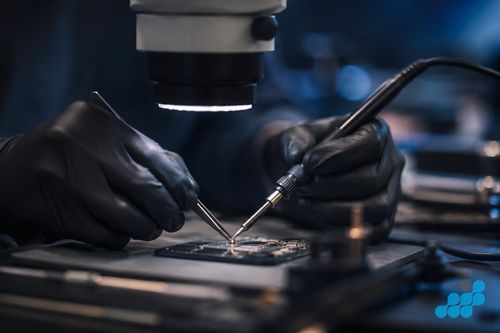
The process is diagnostic and surgical. The technician maps the board's power rails with a multimeter, identifies where voltage is present and where it disappears, and narrows down to the failed component — which might be a charging IC, a backlight driver, a PMIC, or a single shorted capacitor. Under a microscope, the failed component is desoldered with a hot-air station and a new one, sourced from a donor board or a component supplier, is reflowed into place. The board is then re-tested: does it power on, does it boot, can the storage be read? When it can, the data is extracted and the recovery is done. This is the same component-level skill described in our microsoldering and logic board repair explainers, applied here to the single goal of recovering your data.
The great advantage of the microsoldering route is that it preserves the device's own security environment — which, as the next sections explain, matters enormously on modern encrypted phones. If the board can be revived even temporarily, the data can often be extracted through the device's own decryption, which is exactly how it was meant to be read.
NAND chip-off recovery
When the board cannot be revived — when the damage is too severe, or the failure is in a component that cannot be economically replaced — the next option is chip-off: physically removing the NAND memory chip from the board and reading it directly, bypassing the device entirely. This is the literal "remove the chip and read it" technique that gives the field its name, and it is where the work becomes most delicate.
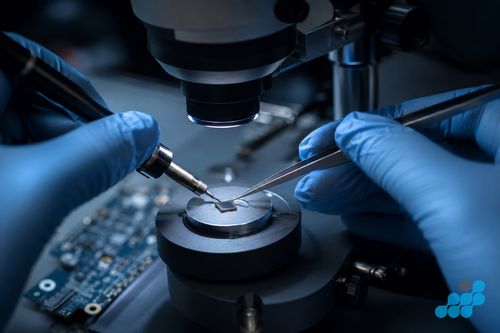
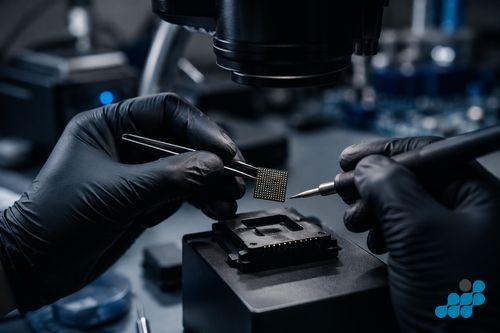
The NAND chip is desoldered from the board using controlled hot air — carefully, because the chip itself is fragile and the pads beneath it are easily damaged. Once removed, the chip is placed in a specialist programmer/reader that speaks the right memory protocol (eMMC, UFS, or a raw NAND interface depending on the chip and device generation). The programmer reads the raw contents of the chip, byte by byte, and the technician then sets about reassembling that raw dump into a usable file system — reconstructing the file tables, carving out individual files, and validating that the recovered data is complete and uncorrupted.
Chip-off is powerful because it does not depend on the board working at all. If the memory chip itself is intact, the data can be read off it regardless of the carnage elsewhere on the board. But it has a critical limitation on modern devices, which is the subject of the next section. See also our clean-room data recovery guide for the related discipline of recovering physically failed mechanical hard drives.
Monolith & in-system (ISP) recovery
Two related techniques round out the toolkit. Monolith recovery deals with storage built as a single monolithic package — common in microSD cards, some USB flash drives, and certain compact devices, where the controller and the memory are fused into one tiny board with no separate chip to "remove." Recovering a monolith means grinding or carefully exposing the microscopic traces on the package and soldering fine wires directly to them so the memory can be read — painstaking, high-skill work.
In-system programming (ISP) recovery is a less destructive alternative where the technician solders directly to the test pads on the memory chip while it is still on the board, reading the chip through its ISP interface without desoldering it. Where it is feasible, ISP is preferable to a full chip-off because it avoids the risk of removing the chip — but it depends on the chip exposing the right pads and on the board not being too badly damaged to allow a stable connection.
Why modern encryption changes the game
Here is the honest part that separates an accurate explainer from a confident-sounding one. On older devices, chip-off was often enough on its own: remove the NAND, read it, reassemble the files, done. On modern phones and many modern laptops, that no longer works, because the data on the chip is encrypted, and the keys to decrypt it are not stored alongside it.
Apple devices use hardware encryption tied to the Secure Enclave, with keys derived from a combination baked into the device's silicon. Many Android devices use file-based encryption (FBE) whose keys are similarly tied to the device's hardware and boot environment. The practical consequence is brutal but important to understand: you can successfully remove and read the NAND chip from a dead modern phone, hold its entire contents in your hand, and still be unable to read a single meaningful file — because the decryption keys live in a chip you may not have, in an environment you cannot replicate.
This is exactly why the approach matters more than brute force. On an encrypted device, the winning strategy is usually to revive the board (via the microsoldering route above) so the data can be decrypted through the device's own security hardware, rather than to pull the chip and hit a cryptographic wall. A recovery bench that understands this distinction — that knows when chip-off will pay off and when it will simply confirm the data is unreachable — is one that will give you an honest answer instead of charging you for a technique that cannot work.
The risks and limits — honestly
We will not give you a fabricated success rate. The truth about board-level recovery is that success depends almost entirely on the specific device, the specific failure, and the condition of the memory — and no responsible bench promises a percentage before examining the device. What we can say honestly is this: where the memory chip itself is intact, recovery is often possible; where the memory itself is damaged (a cracked die, a shorted cell array, catastrophic over-voltage), recovery may be genuinely impossible, and no amount of skill changes that.
There are also real risks. Every intervention on a dead board can make its condition worse — heat applied to desolder a chip can damage adjacent components, and a slip with a probe can lift a pad. An imaging-first process captures readable data as early as possible. Diagnostic, recovery, third-party and return charges are confirmed before work; recovery itself is not guaranteed.
The equipment and skill a real board-level bench needs
Because this work is the hardest tier of recovery, it is worth being specific about what actually sits on a genuine board-level bench — both for customers vetting who to trust with a dead device, and to make clear this is not work a general repair shop can do with a screwdriver kit and a heat gun. The toolchain is specialised and expensive, and the skill to use it is built over years.
The centrepiece is the microscope — board-level work happens at a scale invisible to the naked eye, where a solder joint is a fraction of a millimetre across. Alongside it sits a hot-air rework station with finely controlled temperature and airflow, used to desolder and reflow surface-mount components and the memory chip itself without cooking the silicon or lifting the pads beneath. A soldering iron with a fine tip handles the precision hand-work; preheaters bring the board up to temperature evenly to avoid warping. Diagnosis relies on a digital multimeter and often an oscilloscope, used to walk the board's power rails — checking where a voltage is present, where it droops, and where a short is dragging a rail down to ground.
For the chip-reading side, the bench needs chip programmers and readers that speak the memory protocols of different device generations — eMMC for older phones, UFS for modern ones, and raw NAND interfaces for certain chips — each with its own adapter, pinout and software. Donor boards are kept on hand as a source of known-good replacement components, because a single failed IC often cannot be ordered individually and must be harvested from a board of the same family. Schematic and boardview files — where available — map the board's components and test points, guiding the technician to the right rail and the likely culprit.
The skill, though, matters more than the tools. Knowing which component to suspect, how hard to push a desolder before risking adjacent parts, when a chip-off will hit an encryption wall and a board revival is the better play — that judgement is what separates a bench that recovers data from one that destroys the last good copy of it. It is also why the discipline of working imaging-first, and of stopping to re-evaluate rather than charging ahead, is non-negotiable. Tools can be bought; the restraint and diagnostic instinct cannot, and they are the real thing you are paying for. To see who wields them, our meet the team page introduces the bench.
How celltech approaches it
Our approach follows the principles above. Every case starts with diagnosis — we assess the device, identify the failure mode, and tell you honestly whether board-level recovery is viable before any billable work begins. Where recovery goes ahead, we work imaging-first, choosing the route — microsolder to revive the board, ISP, or chip-off — that best fits the device and respects its encryption model. Board-level and data-recovery work carries a 120-day guarantee, reflecting the complexity of the work (rather than the 27 months that applies to standard component repairs).
Data recovery is priced by the diagnosed route and complexity. Diagnostic, recovery, third-party and return charges are confirmed before work begins. Check the live data-recovery service page for current tiers. The service is available UK-wide by post, with customers arranging suitable tracked inbound postage using the order instructions. For physically failed mechanical drives, see our clean-room recovery guide.
Frequently Asked Questions
What is chip-off data recovery?
Physically removing the NAND memory chip from a device's logic board and reading it directly on a specialist programmer, then reassembling the raw dump into usable files. It is used when the board cannot be revived but the memory chip itself may still be intact.
Can you recover data from a phone with a dead motherboard?
Often yes. If the memory chip is intact, the data is usually still there even when the board is dead. The route is either to microsolder the board back to life long enough to extract the data, or to remove and read the chip — subject to the encryption limits explained above.
Does removing the NAND chip risk the data?
There is always some risk in any board intervention — heat can affect adjacent components, and a slip can damage pads. That is why a proper bench works imaging-first, capturing the data at the earliest point so later work cannot lose what has already been read.
Why can't you just read the chip from an encrypted iPhone?
Because the data on the chip is encrypted, and the decryption keys are tied to the device's own security hardware (the Secure Enclave), not stored on the chip. You can read every byte of the chip and still not decrypt a single file. On such devices the better route is usually to revive the board so the data decrypts through the device's own hardware.
What's the difference between board-level repair and board-level data recovery?
Same microsoldering skill, different goal. iPhone logic-board repair aims to restore the device to working use; board-level data recovery aims only to bring the board back far enough to extract the data. The authorised outcome and published service terms determine how the work is scoped.
Is board-level recovery worth it / what does it cost?
Data recovery is priced after diagnosis according to the required route and complexity. Whether an attempt is proportionate depends on the value of the data and the confirmed terms; see our live data-recovery service page.
Do you do this in-house or outsource it?
Board-level recovery is handled by the celltech repair team and is available UK-wide by post. Customers arrange suitable tracked inbound postage using the order instructions.