Most & Least Repairable Devices UK 2026: Repairability Scores Ranked
Before you buy a phone, laptop or tablet, one question is almost never asked and really should be: how hard will this be to fix when it breaks? A device's repairability decides whether a cracked screen is a £75 afternoon job or a paperwork-heavy, parts-paired ordeal — and on some modern devices, whether it can be fixed at all without going back to the manufacturer. This page ranks 2026's most and least repairable devices using the celltech Repair Index (CRI), our own scoring system built on iFixit teardown scores and extended with real UK bench experience.
Most "repairability" articles you find online are re-quotations of a single iFixit number with no context. We have tried to do better. The CRI adds two dimensions iFixit does not score — parts availability in the real UK market, and economic viability (is the repair worth doing versus replacing the device?) — because those are the factors that actually determine whether a repairable device gets repaired in practice. Every score below is drawn from our repairability dataset, anchored to iFixit, and you are welcome to cite it.
Direct answer: The most repairable devices in 2026 are those with modular batteries, standard fasteners and strong parts availability — modular handhelds like the Steam Deck (4/5) and business laptops like the Lenovo ThinkPad (5/5) lead the field. The least repairable are glued, serialised slabs: folding phones (2/5), the Microsoft Surface family and sealed earbuds. This ranking uses the celltech Repair Index, scored 1–5 across five factors and built on iFixit teardowns plus our bench data.
How we score repairability (the CRI)
The celltech Repair Index scores every device from 1 (effectively disposable) to 5 (designed to be repaired), across five dimensions. The overall score is an honest blend of all five.
| Dimension | What it measures |
|---|---|
| Overall | The headline repairability of the device |
| Parts availability | How easy it is to actually obtain quality parts in the UK market — iFixit does not score this, we do |
| Complexity | How difficult the device is to open and service, mapped from the iFixit teardown score |
| Success rate | How reliably a competent bench can complete the repair without collateral damage |
| Economic viability | Whether the repair cost is sensible relative to the device's value — also our own addition |
The iFixit teardown score (publicly available at ifixit.com/repairability) is the anchor for the complexity dimension, because it is the most rigorous independent assessment of how a device goes together. We extend it with the two market-real dimensions — parts availability and economic viability — drawn from our experience repairing these exact devices for UK customers. Where iFixit says a phone is "7/10 to open", we add: "but the part you need is scarce in the UK and costs nearly what the phone is worth" — and that changes the real-world verdict.
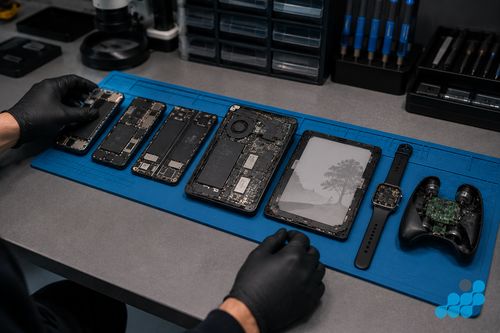
Most repairable phones 2026
Counter-intuitively, the most repairable phones are not the newest flagships. Mature, high-volume handsets score best because their parts ecosystems are deep and cheap, and their construction is well understood by every bench in the country. The original iPhone SE (2016) sits at the top of our index at 5/5 precisely because it is built on mature, abundant internals. Among modern handsets, mid-range Samsung A-series devices like the Galaxy A55 (4/5) score well for the same reason: abundant parts, sensible construction, good value.
| Phone | CRI | Why |
|---|---|---|
| iPhone SE (2016) | 5/5 | Mature parts ecosystem, well-documented construction |
| Samsung Galaxy A55 | 4/5 | Abundant parts, strong economic viability |
| Samsung Galaxy S25 | 4/5 | Good parts availability, standard flagship construction |
| iPhone 17 / 17 Pro | 4/5 | Apple Self Service Repair support, but high flagship parts cost |
Note the pattern: a 4/5 flagship is repairable, but its economic viability is dragged down by expensive panels — an iPhone 17 Pro screen costs far more than an A55 screen. "Repairable" and "cheap to repair" are not the same thing. For what each repair actually costs, see our Apple, Samsung, OnePlus and Xiaomi cost hubs.
Least repairable phones 2026
The bottom of the phone ranking is dominated by folding devices. Folding screens are fragile, expensive and tightly integrated; the hinge mechanisms are complex; and the whole assembly is difficult to open without collateral damage. On our index, the Samsung Galaxy Z Fold6, Z Fold5, Z Flip6 and Z Flip5 all score 2/5. The older Samsung Galaxy S22 family also sits at 2/5, reflecting its tighter construction and scarcer parts relative to newer, higher-volume models.
| Phone | CRI | Why |
|---|---|---|
| Samsung Galaxy Z Fold6 / Fold5 | 2/5 | Fragile folding display, complex hinge, costly parts |
| Samsung Galaxy Z Flip6 / Flip5 | 2/5 | Folding mechanism, tight integration |
| Samsung Galaxy S22 / S22+ / S22 Ultra | 2/5 | Tighter construction, scarcer parts than newer models |
Crucially, a low score does not mean a device cannot be fixed — it means a generalist shop will struggle, and the economics may be tight. A specialist bench with microsoldering capability can still repair many of these; see our board-level repair explainer for what that involves.
Most & least repairable laptops
Laptops show the widest repairability spread of any category, and the divide is almost perfectly along design philosophy. Business laptops, designed for IT departments to service, are consistently the most repairable devices on the market. Consumer ultraportables, designed to be thin above all else, are consistently among the worst.
Most repairable laptops
| Laptop | CRI | Why |
|---|---|---|
| Lenovo ThinkPad | 5/5 | iFixit 7–9/10; service manuals, standard screws, abundant parts — the gold standard |
| HP Pavilion | 4/5 | Accessible construction, good parts availability |
| Dell XPS / Inspiron | 4/5 | Serviceable, well-documented |
| Lenovo IdeaPad / Acer Aspire | 4/5 | Mainstream construction, cheap parts |
Least repairable laptops
At the bottom sits the Microsoft Surface family. Glued displays, difficult-to-open chassis and Alcantara-keyboard bonding have historically earned Surface devices iFixit scores as low as 1/10, and our index reflects that — older Surface Laptop, Surface Go and Surface Book models sit at 1–2/5. The newer Surface Pro 11 is a genuine improvement at 4/5, which is worth noting: manufacturers can change course when they choose to. The discontinued Google Pixelbook also scores poorly at 2/5 for its extremely difficult construction and scarce parts.
For what laptop repairs cost — and why a 4/5 HP screen is far cheaper than a tightly integrated MacBook screen — see our HP, Dell and Lenovo cost hubs.
Tablets, watches & other devices
Tablets lean poorly repairable because they are large, thin, glued glass assemblies. Apple's recent iPad Pro and iPad Air models using glued, serialised displays score 2/5 on our index — the Pro 13" (M4), Air 13" (M2) and Pro 11" (M2) all sit there. The more serviceable iPad (9th Gen) scores 3/5. Samsung's Galaxy Tab S and Tab A range around 3/5.
Among handhelds and wearables, the standout is the Steam Deck at 4/5 — genuinely designed for repair, with official parts and an iFixit partnership, and every major component replaceable. Garmin watches are serviceable for batteries, straps and screens (see Garmin watch repair costs). And at the very bottom of the entire index sit sealed earbuds like AirPods (2/5 and below), where battery replacement is often the only viable service and the rest of the device is effectively disposable.
Is repairability getting better or worse?
The honest, slightly contradictory answer is: both, depending on where you look. The overall direction of travel over the last decade was firmly downwards — thinner devices, more glue, more serialised parts, batteries bonded into place, and a steady drift away from the serviceable, screw-fastened construction that defined earlier generations. That is why the bottom of our index is populated by modern designs, not old ones. The original iPhone SE outscores the newest flagship not because Apple has forgotten how to build a repairable phone, but because the design priorities changed.
But there are genuine signs of reversal, and they are worth crediting. Valve built the Steam Deck for repair from the outset and partnered with iFixit to supply parts — a 4/5 device shipped in the modern era. Apple launched its Self Service Repair programme, which is why the newest iPhones retain a 4/5 despite their flagship parts cost. And Microsoft, long the villain of laptop repairability, improved the Surface Pro 11 to a 4/5 after years of 1/10 iFixit scores — proof that a manufacturer can reverse course when it chooses. The pressure of right-to-repair regulation (see our right to repair UK 2026 guide) is part of what is driving that change.
The net picture for 2026 is a bifurcated market. Devices designed with repair in mind are getting better; devices designed solely for thinness and sealed assembly are not. As a buyer, the trend is your friend: choosing a device on the improving side of that divide protects you financially and environmentally for years.
Repairability at a glance by category
If you want the headline view without the per-model detail, here is where each major device class tends to sit on the 1–5 index:
- Business laptops — the most repairable category (typically 4–5/5).
- Handhelds designed for repair — excellent (Steam Deck, 4/5).
- Modern flagship phones — good but expensive (typically 4/5).
- Mid-range, high-volume phones — good, often better value (3–4/5).
- Mainstream consumer laptops — fair to good (3–4/5).
- Tablets — fair to poor, glued glass (2–3/5).
- Folding phones — poor (2/5).
- Glued ultraportables / older Surface — poor to very poor (1–2/5).
- Sealed earbuds — the least repairable category (1–2/5).
What makes a device repairable?
Step back from individual models and the predictors of repairability are remarkably consistent. A device tends to be repairable when it has most of these traits, and hard to repair when it lacks them:
- A modular, replaceable battery — the single biggest factor. Glued-in batteries turn the most common repair into a risky, destructive procedure.
- Standard fasteners — Phillips and Torx screws, not glue. Screws come out and go back in; glue does not.
- Strong parts availability — a device is only as repairable as the parts market allows. High-volume, mature devices win here.
- No parts serialisation / pairing — when a component is software-locked to a specific device, a perfectly good donor part will not work, which blocks independent repair.
- Documented construction — service manuals and teardowns (think ThinkPad, Steam Deck) make repairs faster, safer and cheaper.
Buying for repairability
If repairability is a factor in your next purchase — and for anything you expect to keep for more than a year, it should be — the data points to clear advice. For laptops, prioritise business-grade machines (ThinkPad, and broadly the Dell/HP/Lenovo business lines) over glued ultraportables. For phones, favour high-volume, mature models over folding flagships, and look up the device's iFixit score before buying. For handhelds, the Steam Deck is the benchmark the rest of the industry should follow. Choosing a repairable device is not just greener — it is almost always cheaper over the device's life, because the inevitable repair will cost less.
The wider policy context matters here too. Parts pairing and serialisation are the live battleground of the repair debate, and the rules around them are moving — see our right to repair UK 2026 explainer for where the law stands, and our repair vs replace environmental impact study for why repairability is an environmental issue as much as an economic one.
One practical tip when buying for repairability: check not just the iFixit score but the parts landscape for the specific model in the UK. A device can score well on a teardown and still be expensive to keep alive if quality parts are scarce or tightly controlled by the manufacturer. The two CRI dimensions iFixit does not cover — parts availability and economic viability — exist precisely to catch that gap, and they are the difference between a device that is theoretically repairable and one that is affordably repairable in the real world. When in doubt, ask a specialist bench what a typical screen or battery costs on that model before you buy; the answer tells you more about lifetime cost than any spec sheet.
Even "hard" devices are repairable by specialists
A low CRI score does not by itself prove that a device is beyond repair. Board-level diagnosis, microsoldering, donor-part experience and appropriate tooling can create options beyond standard component swaps, although viability depends on the individual fault. Our microsoldering and board-level repair guides explain those routes, available through UK-wide postal booking.
For the bigger picture on what all these repairs cost across the UK, our UK Device Repair Report 2026 sets out the full dataset, and the team behind the scoring is introduced at meet the celltech repair team. The decision of whether to repair a hard-to-fix device at all is covered in our refurbished vs repaired vs new guide.
Frequently Asked Questions
What is the most repairable phone in 2026?
Mature, high-volume handsets with abundant parts top the index — the original iPhone SE (2016) scores 5/5, and among modern phones mid-range devices like the Samsung Galaxy A55 (4/5) outscore folding flagships on real-world repairability.
What is the least repairable phone?
Folding phones. The Samsung Galaxy Z Fold6/Fold5 and Z Flip6/Flip5 all score 2/5 on our index, because of their fragile folding displays, complex hinges and costly, tightly integrated parts.
How are repairability scores calculated?
The celltech Repair Index scores devices 1–5 across five dimensions: overall, parts availability, complexity, success rate and economic viability. Complexity is anchored to the iFixit teardown score; parts availability and economic viability are our own additions from real UK bench experience.
Does a low repairability score mean my device can't be fixed?
No. It means a generalist shop will struggle. A specialist bench with board-level microsoldering capability can repair many low-scoring devices that others write off — the score reflects difficulty and economics, not impossibility.
Are iPhones or Android phones more repairable?
It depends more on the specific model and its parts availability than the operating system. Both platforms range from 2/5 (foldables, tight older models) to 4–5/5 (mature, high-volume handsets). Apple's Self Service Repair programme helps newer iPhones; Android strength comes from mature parts ecosystems on popular models.
What makes a laptop easy or hard to repair?
Standard screws, a replaceable battery, service manuals and good parts availability make a laptop easy (ThinkPad, 5/5). Glued displays, bonded keyboards and sealed construction make it hard (older Microsoft Surface, 1–2/5).
Can I cite this ranking?
Yes. Quote any score with attribution to the celltech Repair Index and a link to this page. The index is anchored to iFixit teardown scores and extended with celltech's UK bench data on parts availability and economic viability.