Repair vs Replace: The Environmental Cost of Binning Your Device (UK 2026)
Almost everyone now accepts, in principle, that repairing something is greener than throwing it away and buying new. What is less widely understood is just how much greener — and why. The reason is not the obvious one. It is not mainly about the electricity a phone uses while charging, or the cardboard box the replacement comes in. It is about embodied carbon: the emissions, water and material already locked into a device before you ever switch it on. Once you grasp that, the case for repairing stops being a vague virtue and becomes a hard, measurable saving.
This page sets out the environmental case for repair over replacement with properly attributed figures, and pairs it with celltech's own repair-cost data so you can see the financial case at the same time. Every external statistic is attributed to the body that produced it, and where a figure is genuinely uncertain or quickly dated we say so rather than stating it as a hard fact. For the broader repair-economics picture, this pairs with our UK Device Repair Report 2026.
Direct answer: Repairing almost always beats replacing for the environment because most of a device's lifetime carbon footprint is "embodied" — locked in during manufacture and shipping, before you ever use it. Keeping a device going through repair avoids that upfront impact and keeps it out of e-waste, the world's fastest-growing domestic waste stream. It is also almost always cheaper — a £44.95 battery versus a £500+ replacement phone.
The headline: most of a device's carbon is made before you switch it on
This is the single fact that reframes the whole debate. According to manufacturer environmental reports, the overwhelming majority of a smartphone's lifetime carbon emissions come from its manufacture — the mining and refining of materials, the fabrication of components, the assembly, and the shipping — not from the years you spend using and charging it. Manufacturer product environmental reports (for example those published by Apple, and similar transparency reports from companies like Fairphone) consistently show that production accounts for the lion's share of a phone's lifetime emissions, with actual use making up a much smaller fraction.
We are deliberately not pinning a single percentage to that claim here, because the exact split varies by device, by how many years you keep it, and by how the manufacturer draws the boundary of its report. The robust, source-checkable takeaway is the shape of it: most of the carbon is spent before the device reaches you. The implication is enormous and counter-intuitive. Replacing a perfectly repairable device with a new one does not "reset" its environmental footprint to a small number — it pays the large, upfront manufacturing footprint all over again, while the old device's manufacturing footprint (already paid) is wasted if it is binned.
Repairing, by contrast, spends a tiny fraction of that. The energy and material in a battery swap or a screen replacement is trivial next to the manufacture of a whole new device. So the greenest device is not the newest device; it is the one you already own, kept alive for as long as it can be sensibly repaired.

The UK and global e-waste problem
When a device is replaced rather than repaired, it enters the waste stream — and that waste stream is the world's fastest-growing domestic waste stream, according to the Global E-waste Monitor, the leading international assessment produced by the United Nations Institute for Training and Research (UNITAR) with the ITU and partners. The Monitor reports global e-waste generation in the tens of millions of tonnes per year and rising, with only a minority formally collected and recycled. These are large, sobering figures, and we point you to the Monitor's latest edition rather than quoting a single number that will date.
The UK's position in that picture is unflattering. UK e-waste figures, reported via Material Focus (the not-for-profit delivery body for UK electrical recycling) and the UK's WEEE (Waste Electrical and Electronic Equipment) collection data, show that the UK generates one of the higher per-capita e-waste totals globally, and that a significant quantity of household electronics is hoarded or discarded rather than recycled. UK e-waste collection and recycling is governed by the UK WEEE Regulations 2013, which implement the relevant EU-derived rules and place obligations on producers and distributors to finance the collection and treatment of waste electronics. For the current UK tonnage and recycling rate, consult the latest Material Focus and UK government WEEE statistics rather than a figure that will have moved by the time you read this.
The reason this matters for the repair decision is simple arithmetic. E-waste grows every time a device that could have been repaired is instead discarded. Repair removes a device from the waste stream entirely — not by recycling it, but by keeping it in use. Which is the right segue to the waste hierarchy.
Embodied carbon: what it costs to make a device
Embodied carbon is the total greenhouse-gas emissions from creating a product — extracting the raw materials (cobalt, lithium, rare earths, copper, aluminium), processing them, manufacturing the components, assembling the device, packaging it and shipping it around the world. For electronics, this is material-intensive work: a smartphone contains dozens of elements, several of them mined in energy-intensive conditions and refined through complex supply chains.
The framing organisations use for this — the "embodied versus in-use" split, and the idea of treating a manufactured product as a store of already-spent carbon and materials — draws on work by circular-economy bodies such as the Ellen MacArthur Foundation and repair-focused groups like The Restart Project. The Restart Project, in particular, has done accessible work on the lifetime emissions of consumer electronics and the case for repair; we cite them as advocacy/research context. The point these bodies make, and which the manufacturer reports corroborate, is that for small electronics the use-phase emissions are dwarfed by the production-phase emissions. That is why keeping a device in service — through repair — is the single most effective thing an individual can do to cut its lifetime footprint.
Beyond carbon: the materials and water footprint
Carbon is the headline metric, but it is not the only environmental cost folded into a device. Manufacturing electronics is also material- and water-intensive. A single smartphone contains dozens of elements — including copper, cobalt, lithium, nickel, aluminium, tin, gold, silver and various rare earths — each of which must be mined, refined and processed, with associated land disruption, water use and often significant social and environmental impacts in the regions where extraction happens. These are documented concerns, raised by environmental and human-rights organisations and increasingly by the manufacturers' own supply-chain reporting; we point you to those reports rather than restating contested specifics.
The point for the repair decision is that these material impacts, like the carbon, are upfront. Every gram of cobalt, every drop of refining water, every hectare of mining disruption is already "in" the device you hold. Discarding a repairable device wastes all of that embedded material; repairing it keeps it in productive use and defers — or entirely avoids — the need to extract those same materials again for a replacement. In resource terms, the device in your pocket is a concentrated store of scarce materials that were expensive, in every sense, to assemble. The longer it stays in service, the better that investment pays off environmentally.
This is also why repair and responsible recycling are complementary rather than competing ideas. Repair maximises the useful life of the concentrated materials already inside a device; recycling, when a device finally reaches true end of life, is the fallback that tries to recover those materials for the next product. Neither replaces the other, and both are undermined by the habit of discarding repairable devices early. The systemic fix — keeping devices in use longer through repair — is what shrinks demand for virgin extraction at the source.
What repairing actually saves
Repairing instead of replacing saves on three fronts at once: carbon (you avoid paying the manufacturing footprint of a new device), waste (you keep a device out of e-waste), and money (repair is almost always a fraction of the replacement cost). Our own repair-cost data shows the money side clearly. An iPhone 13 battery replacement is £44.95 against a replacement phone costing many hundreds of pounds; an iPhone 13 screen is £74.95; even a flagship screen at £279.95 is a small fraction of a new handset — see our Apple and Samsung cost hubs for the full picture.
Crucially, the greenest and lowest-priced repair is the one that targets the single failed component rather than replacing a whole module. A board-level repair that swaps one failed IC avoids the embodied carbon of an entirely new logic board — and it usually saves your data too, which a board replacement often destroys. That is why specialist component-level repair, of the kind described in our board-level repair and chip-off data recovery explainers, is environmentally significant, not just economically significant.
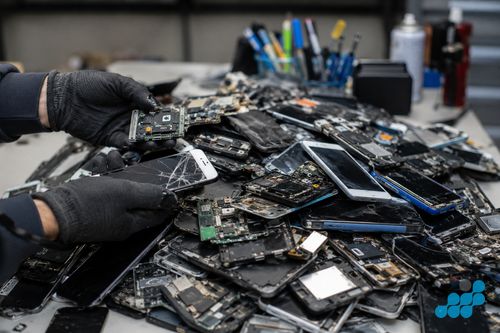
Repair beats recycling (and recycling beats landfill)
There is a common and reassuring misconception that recycling a device cancels out the environmental impact of replacing it. It does not. Recycling recovers some materials, but it is energy-intensive, it cannot recover everything (and often recovers only a fraction of the critical metals), and it does nothing about the carbon already spent manufacturing the device you are discarding or the new one you are buying. The waste hierarchy, as set out in environmental policy and reflected in the UK WEEE regime, ranks options from best to worst: prevent (don't create the waste) is best, then reuse (keep the device in use, by repair), then recycle, then recovery, with disposal (landfill) last.
Repair sits at the top of that hierarchy — it is prevention and reuse combined. Recycling sits below it, and is far better than landfill, but it is not a free pass. So the order of preference when a device fails is: repair it if that is economically and safely possible; if it truly is beyond repair, recycle it responsibly through a proper WEEE route (never bin it); and only then consider a replacement. For devices that are functional but unwanted, refurbishment and resale keep them in use and out of the waste stream entirely — see our refurbished vs repaired vs new guide.
When replacing is the right call
An honest environmental guide has to admit that replacing is sometimes the correct choice, and pretending otherwise undermines the credibility of the whole case. Replacing makes sense when the device is genuinely beyond economic or safe repair — a board physically crushed, a device so comprehensively liquid-damaged that no repair will restore it, or a repair whose cost exceeds the device's residual value. It can also make sense when a much older, far less energy-efficient device is being replaced by something dramatically more efficient over a long enough payback period, though for small electronics the embodied carbon usually dominates and this argument is weaker than people assume.
Even in the replace case, the responsible move is to handle the old device properly — refurbish it, pass it on, trade it in, or recycle it through a certified route so its materials and any remaining useful life are recovered rather than landfilled. The aim is not "never replace"; it is "repair first, replace last, and never bin." When a replacement is genuinely necessary, choosing a repairable device for the replacement (see our repairability ranking) ensures the next device stays in service for longer too, compounding the environmental benefit over the years that follow.
The money side: a worked repair-vs-replace comparison
The environmental case and the financial case point the same way, and seeing them side by side is the quickest way to make the decision feel real rather than abstract. Take a common scenario: an otherwise-good iPhone 13 with a degraded battery. The repair is a £44.95 battery replacement; a replacement handset of equivalent spec runs into many hundreds of pounds. The repair keeps the entire device — screen, logic board, cameras, the lot — in service, avoiding the embodied carbon of manufacturing a whole new phone. The replacement pays that manufacturing footprint again, and the old device is discarded unless it is responsibly recycled. Cheaper and greener, by a wide margin.
The same shape holds across repair types. A cracked iPhone 13 screen at £74.95 is a fraction of a new handset and preserves everything else in the device; even a high-end screen replacement at £279.95 on a flagship phone still comes in well below the cost of replacing the device, and still avoids the bulk of the replacement's manufacturing footprint. The detail for every model lives in our Apple and Samsung cost hubs, but the pattern is consistent: because most of the cost and most of the carbon of a device is locked into its manufacture, the repair that targets only the failed component almost always wins on both fronts at once.
The decision only tips the other way when a repair approaches or exceeds the device's remaining value, or when the device is genuinely beyond safe repair — and even then, the greenest move is to refurbish or responsibly recycle the old one rather than bin it. For help thinking that through, our repair vs insurance claim and refurbished vs repaired vs new guides walk the economics in detail.
What you can do
- Repair first. Before replacing, get a diagnosis from a specialist bench. Most faults — screens, batteries, charging ports, even many board failures — are economically repairable.
- Keep devices longer. Because most of the footprint is upfront, every extra year of use dilutes the per-year environmental cost of the device you already own.
- Buy for repairability. When you do replace, choose devices that are easy to fix — see our most repairable devices 2026 ranking.
- Recycle responsibly. Never bin electronics. Use a proper WEEE collection point so materials are recovered.
- Refurbish and pass on. A working device you no longer want has years of life for someone else.

Frequently Asked Questions
Is it better for the environment to repair or replace a phone?
Repair, almost always. Most of a phone's lifetime carbon is embodied in its manufacture, so replacing it pays that large upfront footprint again while wasting the one already spent. Repairing keeps the device in use and out of e-waste, and is almost always cheaper.
How much CO2 does making a new smartphone produce?
The majority of a smartphone's lifetime emissions come from manufacture rather than use, according to manufacturer environmental reports (e.g. Apple, Fairphone). The exact percentage varies by device and report boundary, so check the manufacturer's product environmental report for the specific model rather than relying on a single rounded figure.
How much e-waste does the UK produce?
The UK generates one of the higher per-capita e-waste totals globally, with a significant quantity hoarded or discarded rather than recycled. For the current tonnage and recycling rate, consult the latest Global E-waste Monitor (UNITAR/ITU) and Material Focus / UK government WEEE statistics.
Does recycling a device make replacing it okay?
Not fully. Recycling sits below repair in the waste hierarchy — it recovers some materials but does not undo the carbon spent making the old device or the new one. Repair first; recycle (through a proper WEEE route, never the bin) only when repair is genuinely impossible.
When is replacing genuinely the better option?
When the device is beyond economic or safe repair — a crushed board, catastrophic liquid damage, or a repair costing more than the device is worth. Even then, the old device should be refurbished, traded in or recycled responsibly rather than binned.
How does repair compare to buying refurbished?
Both keep devices in use and out of the waste stream. Repairing your own device is usually the greenest and lowest-priced option because it preserves the device you already own; buying refurbished is the next-best choice when your device truly cannot be repaired. See our refurbished vs repaired vs new guide for the full comparison.
What should I do with a device I can't repair?
Recycle it responsibly through a proper WEEE collection point, trade it in, or pass it to a refurbisher. Never bin electronics — the materials can and should be recovered, and many devices others consider dead are repairable by a specialist bench. For the policy backdrop, see our right to repair UK 2026 guide.